A great offset smoker is about more than the cooking chamber. It is also about where you set a hot pan, how you move the pit out of the garage, whether the trailer wiring survives regular use, and how much work it takes to keep everything looking good.
That is what caught my attention about TMG Pits in Knoxville, Tennessee. I have seen plenty of beautiful smokers mounted on trailers, but these rigs feel designed as complete cooking setups rather than a smoker simply bolted onto whatever trailer was available.
After spending time at the shop with Brandon, one of the Metal Guys behind TMG, I came away with a better understanding of why. Their approach combines metal fabrication experience, a family connection to barbecue, and lessons learned cooking at charity events, pop-ups, and catering jobs. The details are not just there to look impressive. Many solve problems you only appreciate after feeding a crowd.
Key Takeaways
- TMG designs trailers around cooking workflow, with integrated workspace, storage, and heavy-duty construction.
- A larger, well-designed offset can be more forgiving than a small smoker.
- Choose mobility and cooking capacity based on future gatherings, not just everyday meals.
- Practical upgrades outside the cooking chamber can improve storage, transport, and long-term maintenance.
Table of Contents
- Build the Trailer Around the Pit, Not the Other Way Around
- From Custom Metal Signs to Custom BBQ Pits
- Tank Smokers With Some Personality
- Offset Smoker Design: Airflow, Adjustability, and Real Cooking
- Choosing a Backyard Pit, Off-Road Cart, or Trailer
- Useful Innovation Is Not Always Inside the Cook Chamber
- Custom Builds With Three Non-Negotiables
- Tennessee Barbecue, Live Fire, and What the Builder Cooks On
- What Stood Out Most About TMG Pits
Build the Trailer Around the Pit, Not the Other Way Around
Brandon’s background in landscaping helps explain TMG’s approach to durability. His crews were hard on equipment, and trailers needed frequent repairs, including damaged wiring. Having welding equipment became a necessity long before building smokers became the business.
When TMG started making barbecue trailers, that repair experience informed the design. Brandon already knew where equipment could fail and wanted to address those weak points from the beginning.
Their starting point is the pit and the cooking workflow, not a standard trailer with a smoker added afterward. The goal is for the entire rig to work together.
That matters because cooking capacity and working capacity are two different things. A 500-gallon smoker might hold plenty of food, but you still need somewhere to prep, organize pans, and serve.
You Can Almost Never Have Too Much Shelving
Rob Troxler, the neighboring business owner who helped get TMG started building pits, pushed hard for shelving on the early builds. Brandon was not immediately convinced just how much they needed. Then he cooked on one.
That settled it.
TMG’s stainless steel flip-up work surfaces can cover wood storage while giving the cook a substantial prep or serving area. Brandon recalled using the full 16 feet of shelving on Chris Stafford’s rig as a serving line during a charity event.
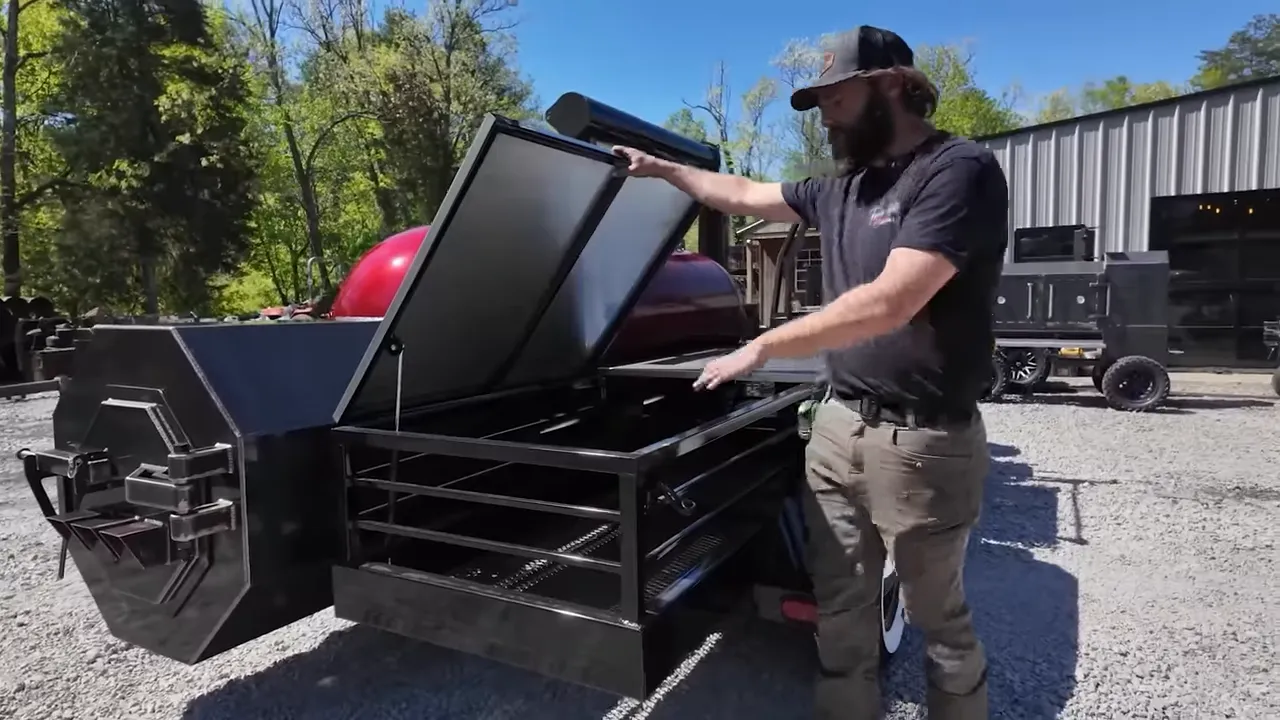
I had recently cooked 100 sausages on a borrowed 500-gallon smoker at a charity event, and the lack of workspace was impossible to ignore. We needed extra folding tables just to organize and serve the food.
There is nothing wrong with bringing tables. But when the rig already includes useful working space, that is one less problem to solve at every event.
From Custom Metal Signs to Custom BBQ Pits
TMG’s story did not begin with a plan to become a major smoker manufacturer. The business took shape in Brandon’s home garage, initially making custom metal signs before moving into smokers.
The first smoker was intended for Rob next door. Someone came into the shop, liked it, and asked to buy it. TMG built another, and that sold too. Those early sales suggested they were onto something.
Then a smoker posted online gained traction on TikTok, helping push the business forward. No dancing required. Just some genuinely cool metalwork.
By the time of my visit, both backyard smokers and tank offsets were keeping the shop busy. Brandon described lead times that had ranged from roughly four months to a year, with the backlog previously reaching 14 months before additional staff helped bring it down. Those were the circumstances at the time, not a promise about what a new order would take today.
Fabrication Runs in the Family
Brandon grew up with barbecue as part of family holidays. Visits to his grandfather’s house also often meant working on a project, including metalwork and welding.
His father was a third-generation ironworker. Brandon distinguishes his own fabrication-shop work from ironworking, but the family connection is clear.
The funny part is that neither his father nor grandfather wanted to teach him to weld. They knew how demanding the work was and encouraged him to go to school instead. Now his dad stops by the shop and gets to point out that, after all that schooling, Brandon still ended up working with metal.
That combination of barbecue memories and fabrication experience helps explain why the pits are both cooking equipment and creative projects.
Tank Smokers With Some Personality
When I asked Brandon what he most enjoyed building, the tank smokers stood out. Each tank has its own character, and the larger format gives the team room to do more artistic fabrication.
TMG does not limit itself to one finish or one visual style. Builds can feature natural patina, custom paint, or painted patina treatments. Their off-road packages add distinctive fabricated parts rather than relying entirely on a conventional industrial look.
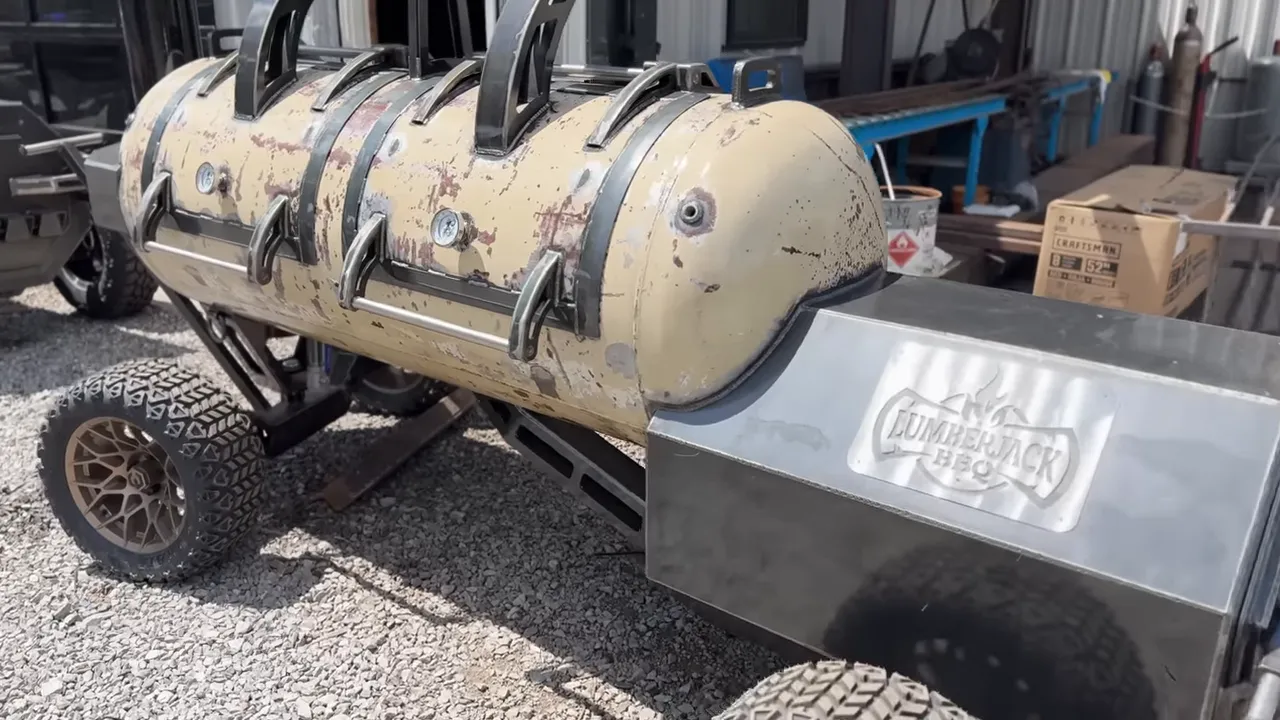
Some of those details take extra shop time. Brandon sees that as worthwhile when the finished pit looks more cohesive.
That philosophy extends to custom trailers. A smoker can be designed to complement a customer’s vehicle, including matching paint and wheels. Brandon gave the example of an older Chevy C10 with a matching trailer build, potentially incorporating airbags.
It is a different proposition from choosing a stock smoker and accepting the available cart. The way the equipment looks and moves can be part of the design conversation from the start.
Offset Smoker Design: Airflow, Adjustability, and Real Cooking
There is no shortage of strong opinions about offset smoker design. Some people want computational fluid dynamics modeling. Others arrive at a design through repeated testing, changing stack height, collector shape, and placement until the pit behaves the way they want.
TMG’s early development leaned heavily on trial and error.
They started with smaller backyard pits, which Brandon considers more challenging to get dialed in with a traditional-flow design. Larger fireboxes and tanks give heat more room to develop and move through the cooker more gently. On a smaller pit, the margin for error is tighter.
The team experimented with stack placement and collectors, learned from those changes, and then scaled the designs up. One important lesson was that pit length matters, not just the gallon capacity printed beside the model name.
Why TMG Uses Large Stacks
Brandon’s stack philosophy is straightforward: provide enough draw, then give the cook the ability to reduce it. An undersized stack does not offer the same flexibility because you cannot simply adjust it beyond its physical capacity.
That is also why TMG includes options for managing airflow through the firebox door and its dampers. Different cooks prefer different approaches, and Brandon does not want the pit designed around only one person’s habits.
That adjustability is useful, but it does not remove the need to learn the cooker. The right fire and airflow settings still depend on how that particular pit responds.
A Bigger Offset Can Be Easier to Run
This is something I wish more people could experience before judging offset cooking by a frustrating session on an inexpensive big-box-store smoker.
With most vehicles, the smaller machine is easier to handle. A Mini Cooper is more approachable than a big rig. Offset smokers can feel like the opposite.
In my experience, a well-designed 500- or 1,000-gallon offset can be surprisingly straightforward to run once someone explains the basics. Meanwhile, a small, less forgiving offset can keep even an experienced cook busy trying to maintain a suitable fire.
Brandon agreed that it is easy to build too much fire in a small cooker. A larger pit gives you more room for that fire without the same immediate temperature consequences.
Still, neither of us considers a larger smoker a substitute for fire management. Whatever brand is on the door, you need to learn its behavior rather than assume the routine from your previous pit will transfer perfectly. That learning process is part of the fun.
Choosing a Backyard Pit, Off-Road Cart, or Trailer
One of Brandon’s most common questions is not about paint or stack dimensions. It is simply which configuration someone should buy.
His advice starts with movement:
- Mostly stationary on a patio: Casters can be a sensible choice if the smoker will stay in one place.
- Regular trips in and out of the garage: Consider an off-road package that is better suited to moving a heavy pit around the property.
- Cooking at other locations: A trailer makes more sense when the plan includes a friend’s house, family events, or other off-site cooks.
These are not lightweight grills. Brandon referenced a recent backyard build weighing around 700 to 800 pounds, with larger configurations reaching several thousand pounds. Portability needs to be considered before the smoker is sitting in your driveway.
For me, that is one of the biggest things to think through with a backyard offset. Owning a great pit is one thing. Being able to get it where you want to cook is another.
Buy for the Cooking You Are Likely to Grow Into
I have owned seven offsets, and I have never moved to a smaller one.
Brandon sees a similar pattern. Customers have traded a 36 model for a 48 or 60, but he could not recall someone trading a 60 down to a 36.
The reason is familiar to anyone whose barbecue has become popular. You start cooking for yourself. Then the neighbors want some. Then the church calls. Suddenly, the capacity that seemed generous is not enough for 60 or 100 people.
I managed to get myself into that situation when a church asked about feeding 400 people. That is the sort of request that makes a trailer pit seem very reasonable, very quickly.
If your budget, space, and actual needs support the next size up, it deserves serious consideration. That is not an argument for buying the biggest smoker available. It is a reminder to account for family gatherings and community cooks, not only an ordinary dinner.
Larger Does Not Automatically Mean a Huge Wood Bill
Fuel consumption is another concern that can push people toward a smaller pit. But size alone does not tell the whole story.
Brandon highlighted TMG’s 250-gallon smoker with its 3-inch insulated firebox. Customers sometimes call because they are surprised that a relatively small fire is holding the cooker around 225°F to 250°F.
In his experience, some larger insulated pits can use wood more efficiently than smaller models. He suggested that a 250 could even use less wood than a 36 model in some circumstances.
My own experience with insulated fireboxes has also been that the fuel difference can be much smaller than expected. I am not presenting a controlled 500-gallon-versus-backyard comparison, because I have not done that test. The practical lesson is to ask about the whole design rather than assume wood consumption rises directly with chamber size.
Useful Innovation Is Not Always Inside the Cook Chamber
I love a new idea, but being different is not automatically the same as being better.
Brandon’s view is that technology and innovation should keep moving the industry forward. TMG began with two CNC tables, which gave the team capabilities that differed from shops still hand-cutting components. Their hinges and fabricated details reflect that approach.
At the same time, he does not believe every good smoker needs to reinvent airflow.
Customers often ask about deflector plates or additional internal features. Brandon’s position is that, in TMG’s testing, proper fire management already allows them to use about 95 percent of the cooking area. If the pit is producing good food across that much of the chamber, he does not see a need to add complexity simply to have another feature.
That is not a claim that every alternative design is wrong. It is a distinction between a change that solves a demonstrated problem and a change that merely creates something new to advertise.
A Powered Raising Stack
One feature that caught my attention was an electronically raised stack TMG had shared on a custom build. A tall stack is useful during cooking, but bringing it down can help with storage and transport.
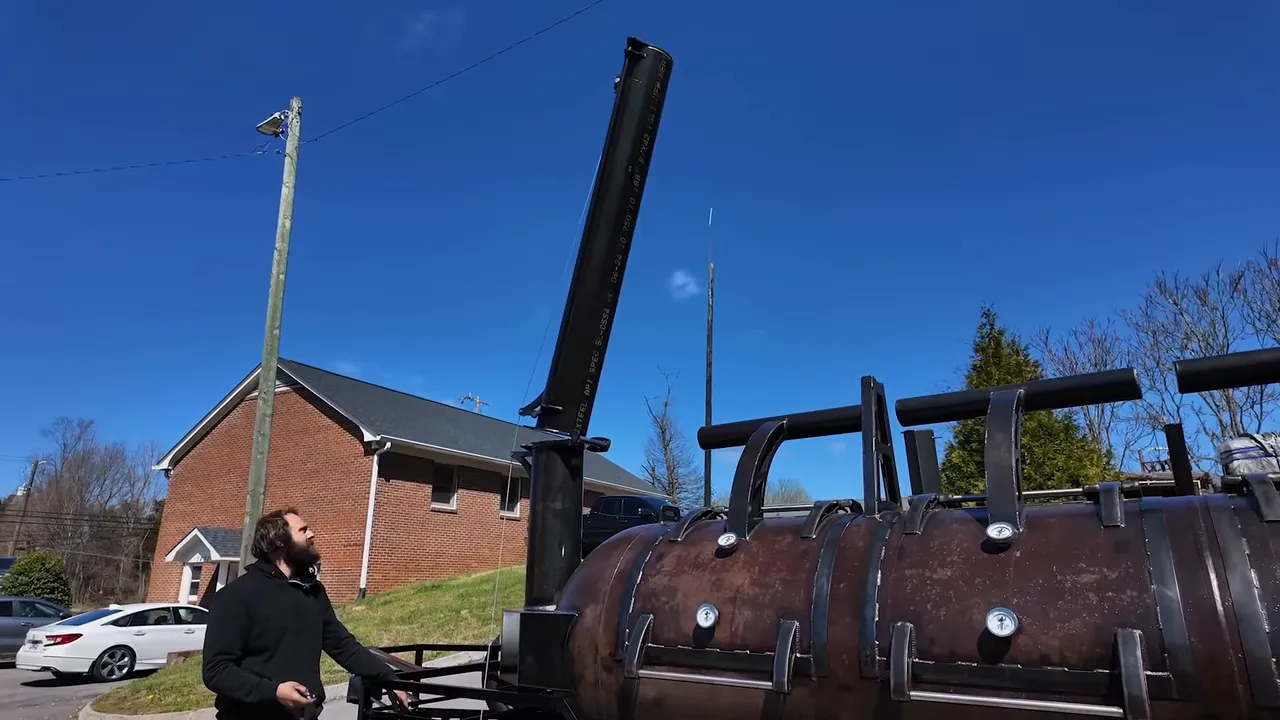
That is the kind of innovation I appreciate: a practical improvement outside the cooking chamber that makes the entire rig easier to live with.
Powder-Coated Trailer Frames
Another development was TMG’s move into powder coating complete trailers. The shop had powder-coated smaller items for years, but a larger setup was making full trailer frames possible.
During my visit, Brandon said they expected to coat their first complete trailer that day. He described the new equipment as accommodating trailers around 22 feet long, with roughly 24 feet representing the upper end of what could fit.
For anyone unfamiliar with the process, the Powder Coating Institute provides useful background on powder coating.
Brandon was careful not to describe it as an indestructible finish. Powder coating can still chip and scratch. He considers it a more durable finish than paint for their application, and it also helps streamline the shop’s finishing process.
That matters to me because any trailer pit I own would need to live outside. A finish that reduces maintenance is a meaningful upgrade, particularly in a colder climate.
A Better Finish Still Needs Care
No finish eliminates maintenance. Brandon compared a neglected pit to a truck left under a tree without being washed. Outdoor exposure and lack of care will eventually show.
I have let a smoker go before, and bringing it back took days of reconditioning. I would not want to repeat that job on an entire trailer rig.
The goal is not to pretend maintenance disappears. It is to build equipment that lets you spend more time cooking and less time trying to revive it every spring.
Custom Builds With Three Non-Negotiables
For someone considering TMG without being able to visit the shop, Brandon emphasized that they are a custom builder. Off-road packages and highly customized trailers are a significant part of what makes the business different.
That flexibility comes with three requirements:
- The build must meet their quality standards.
- It must work properly.
- It must look good.
The third point is not an afterthought. Brandon said TMG has turned down work when a requested design would not meet their expectations for appearance.
Custom work also takes time and can slow production. Brandon explained that other pit builders have referred customers to TMG when those customers wanted off-road packages or more involved trailer customization that the other shops did not want to take on.
For someone who wants a complete rig tailored to how they cook, move equipment, and present their business, that willingness to customize is important.
Seeing a TMG Pit in Person
The Knoxville shop is one place to see the equipment firsthand. At the time of our conversation, Brandon also identified dealer locations in Texas and Arizona through Golf Cart King and Over the Fire Barbecue.
The team occasionally takes pits to events outside Tennessee as well. For a substantial purchase, getting hands-on with door operation, workspace, and overall scale can answer questions that product photos cannot.
The business had also reached well beyond East Tennessee. Brandon estimated that TMG pits were in 12 or 13 countries, including Canada, with UK distribution helping get smokers into Europe. That is quite a reach for a fabrication business that began in a home garage.
Tennessee Barbecue, Live Fire, and What the Builder Cooks On
Spending time in Tennessee is also a good reminder that excellent barbecue is not limited to the styles that dominate online discussion.
Family road trips, stops around Knoxville and Johnson City, time in Nashville, and competing at Memphis in May have given me plenty of appreciation for the state’s regional barbecue character.
Brandon takes a relaxed approach to those boundaries. Some of the cooking he grew up with in the early 1990s resembles what gets labeled Texas-inspired barbecue today. He also sees regional styles increasingly influencing one another as cooks share ideas and experiment.
His priority is good food rather than protecting a label. I am with him on that. Tennessee has plenty of barbecue worth stopping for, including the roadside places that might not get the recognition they deserve.
Dry Ribs Should Not Mean Dried-Out Ribs
Our discussion of dry versus wet ribs needed a little clarification. Were we talking about sauce, or ribs that were actually dry?
Neither of us wants the latter. Brandon wants ribs cooked low and slow that finish juicy, properly rendered, and full of flavor. Sometimes he sauces them, and sometimes he does not.
He is less enthusiastic about a heavy application of dry rub right at the end when it leaves the eating experience feeling dry. Given the choice, a little sauce or a good glaze is right in his comfort zone. Mine too.
The Pit That Actually Made It Home
I had to ask what a smoker builder keeps at his own house.
The answer was not quite what I expected. Brandon had built himself two or three pits, but they sold before making it home. A cooker built for Hayes met the same fate. Even a smoker intended to stay at the shop for charity cooks was sold within days when someone needed one immediately.
At the time, Brandon’s home cooker was the Forge, TMG’s live-fire grill. He enjoys the challenge and the attention live-fire cooking requires. At home, he can stay close and manage it.
He was also planning a personal camping build: a 250-gallon smoker on an off-road trailer with 35-inch tires, designed to match his older Suzuki Samurai. It would demonstrate the shop’s ability to match a cooking rig to a vehicle.
Whether that one actually stays his is another question. Based on the history, I would not bet against someone asking to buy it.
What Stood Out Most About TMG Pits
The biggest takeaway from my time in Knoxville was not one stack dimension, finish, or custom paint job. It was the attention paid to the entire cooking experience.
A smoker needs to manage fire and produce great barbecue. But a trailer rig also needs useful shelves, sensible storage, durable construction, and a layout that still makes sense when you are busy feeding people.
TMG’s approach is compelling because those details come from both sides of the business: building the equipment and actually cooking on it. The result is more than a good-looking offset. It is a pit designed with the work around the barbecue in mind.


