Team pellet versus team offset can get into borderline religious territory. But take away the logos, the firebox, and the person explaining why their cooker is superior, and a much more useful question remains: can friends and family actually taste the difference?
After a trip to Texas, where offsets dominate the barbecue scene, I wanted to put that question to a backyard test. I bought a two-rack pack of beef ribs, cooked one on my Traeger and the other on an offset, and asked people to choose their favorite without knowing which cooker produced it.
The result was unanimous for the offset. But the interesting part is why it won, how close the finished ribs looked, and whether that extra flavor makes an offset the right choice for your life.
Key Takeaways
- Every invited taster preferred the offset beef ribs for their deeper smoke flavor.
- The offset developed bark much earlier, while the pellet rack needed nearly the full cook.
- A supplemental smoke tube boosted the pellet setup but did not erase the flavor difference.
- Pellet grills offer greater convenience, while offsets require availability for timely fire management.
Table of Contents
- I Don’t Hate Pellet Grills. My Friend Aaron Is Another Story.
- How I Set Up the Beef Rib Comparison
- Pellet Convenience vs Offset Fire Management
- Beef Rib Prep: Keep It Simple
- The Biggest Cooking Difference Was Bark Development
- The Blind Taste Test: Everybody Picked the Offset
- Which Smoker Would I Choose?
- A Smart-Control Option for an Analog Smoker
I Don’t Hate Pellet Grills. My Friend Aaron Is Another Story.
My pellet-grill origin story starts with our friend Aaron. About 10 to 15 years ago, he cooked ribs on a pellet grill for the first time and turned out a rack better than mine. Sarah, my wife, is always happy to confirm that detail.
Naturally, I responded in the most reasonable way possible: I became obsessed with barbecue, competed at Memphis in May, and traveled to Texas to learn from pitmasters.
All kidding aside, Aaron’s ribs demonstrated something important. Pellet grills make excellent barbecue accessible. Not everyone wants fire management to become a second hobby, and not every stage of life leaves room for it.
I also saw plenty of pellet cookers around competition barbecue at Memphis in May. So this wasn’t a test designed to prove that pellets can’t make good food. I wanted to find out whether the extra attention an offset requires produces a difference that ordinary people appreciate.
How I Set Up the Beef Rib Comparison
The two racks came from the same package and looked very similar, making them a useful starting point for a side-by-side cook.
- Pellet cooker: My own Traeger, which I purchased.
- Offset smoker: A prototype Trillium from Smoke North, on loan for testing.
- Seasoning: The same binder, fresh black pepper, and seasoned salt on both racks.
- Cooking approach: Keep temperatures as close as practical while giving each cooker its best chance.
- Judging: Friends and family chose the smoke flavor they preferred without being told which ribs came from which smoker.
For transparency, I’m a Smoke North customer and live less than an hour from the shop. That proximity gives me opportunities to test prototypes and pass along design feedback. Smoke North also provided product support for this project.
This was a practical backyard comparison, not a laboratory experiment. The goal was to cook both racks well, rather than force identical handling when the bark developed differently.
Pellet Convenience vs Offset Fire Management
If your day leaves no room to interact with a smoker, a pellet grill is likely the better fit. An offset needs someone available to manage its fire, even when the individual visits to the firebox are brief.
That said, pellet cooking isn’t maintenance-free. On my Traeger, ash-pot cleaning comes around roughly every 20 hours of use, or about a brisket cook. There’s time spent removing components and vacuuming ash that doesn’t necessarily get counted in the convenience conversation.
This is where Sarah would accuse me of doing a little “boy math.” Add up a handful of short firebox visits and compare them with pellet-grill cleanup, and the total hands-on minutes can look closer than you’d expect.
But total effort and availability are not the same thing. Cleaning a cold pellet grill can happen before or after a cook. Adding wood has to happen when the fire needs it. No amount of creative accounting gets around that.
Three Texas-inspired techniques I used
I brought home three ideas from Texas that shaped this cook:
- Start with a bundled wood fire. In an earlier test, this approach gave me about three hours around 200°F with very little intervention. For these ribs, I wanted a similar low-temperature opening stretch before moving to regular additions of one or two splits as needed.
- Plan for a long hot hold. An overnight hold gives the cook a different rhythm and, in my experience, lets the stronger early smoke character mellow.
- Pull before the final tenderness endpoint. Rather than finish the ribs completely on the smoker, I stopped around 195°F and allowed the hot hold to finish the process.
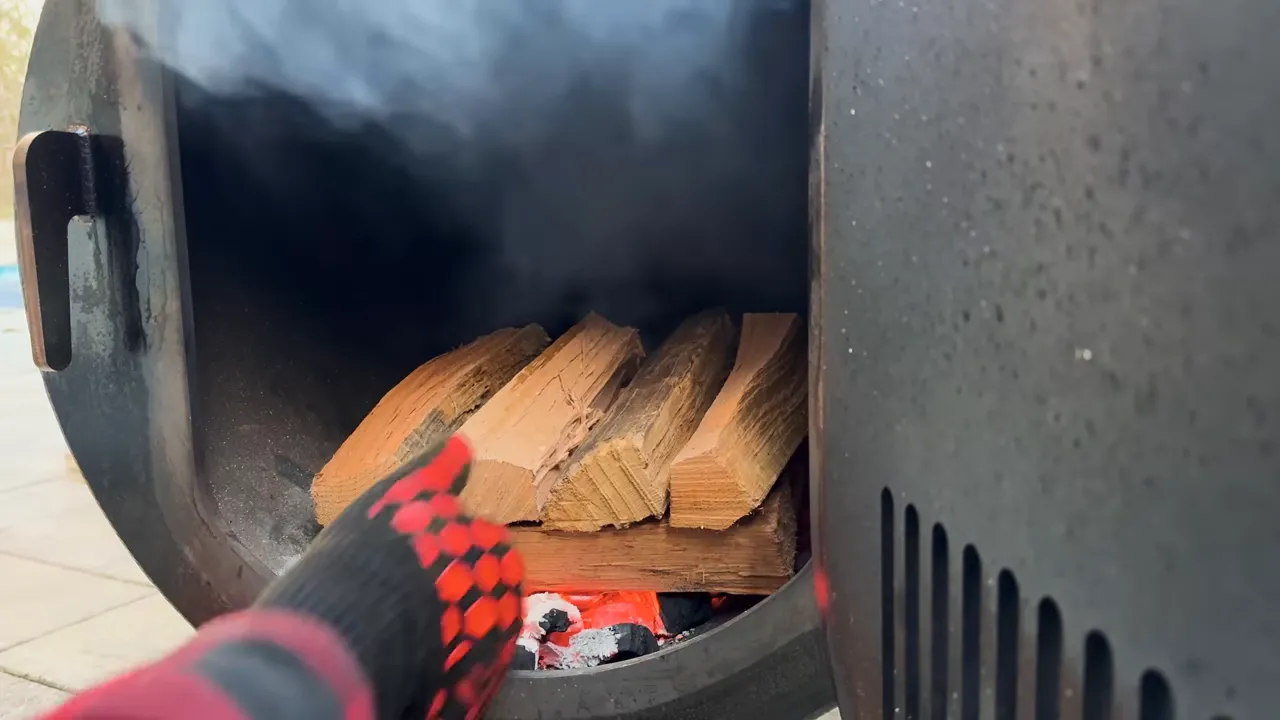
The low-temperature opening is sometimes described as a “cold smoke,” but at roughly 200°F, we’re talking about low-and-slow cooking, not traditional cold smoking.
Giving the pellet grill a smoke boost
A common criticism of pellet grills is their lighter smoke profile. To give the Traeger its best chance, I added a supplemental pellet smoke tube.
My small tube runs for only a couple of hours, so I refilled it through the day, just as I continued adding splits to the offset. If you like your pellet grill but want more smoke flavor, a smoke tube is one approach worth trying. In this comparison, the pellet cooker wasn’t relying on its normal smoke output alone.
Beef Rib Prep: Keep It Simple
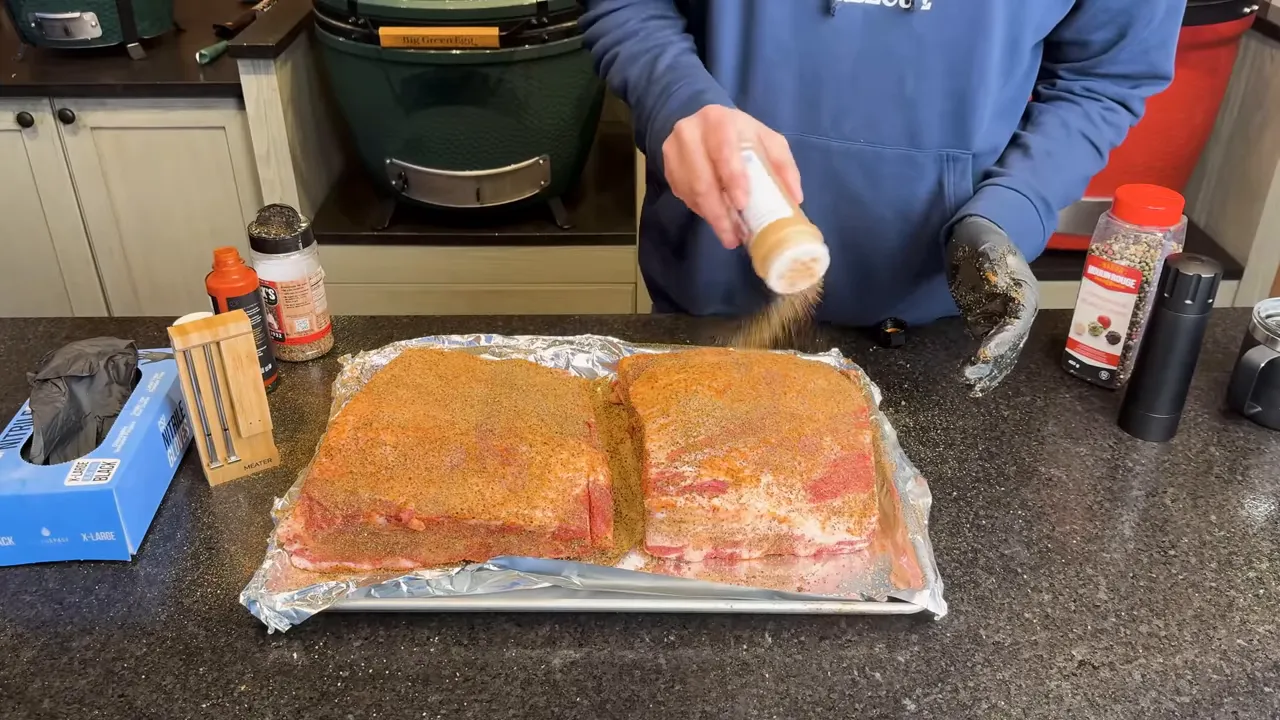
I kept the seasoning Texas-inspired and straightforward. Big beef ribs don’t need an elaborate rub to make a statement.
- Binder: A light coating of Truff hot sauce.
- Pepper: Freshly cracked black pepper.
- Salt seasoning: Fiesta seasoned salt.
The binder is optional. I like the savory, umami character the hot sauce adds to beef, including steaks, brisket, and these big ribs.
During my time cooking with Cooper in Texas, he used a Rio all-purpose seasoning. Think along the lines of Lawry’s or Fiesta seasoned salt, although the Rio blend I tried had a more pronounced black-pepper character. I had Fiesta on hand, so that’s what went on both racks, along with fresh pepper.
I inserted wireless probes using my MEATER Pro Duo to track the ribs through the day. The system communicated through the offset’s thick, 3/8-inch cooking chamber and sent readings to my phone and watch.
During the cook, I spritzed both racks with a vinegar-and-water mixture. The pellet tube stayed in rotation on the Traeger, while the offset received wood splits as needed to keep the cooking temperatures comparable.
The Biggest Cooking Difference Was Bark Development
The offset developed its bark much sooner. This direct-flow smoker moves a lot of hot air through the chamber, and the surface of the ribs showed it.
At around 165°F internal temperature, the offset rack already had the dark, developed bark I wanted. I wrapped it in butcher paper to protect that bark from drying out while the meat continued cooking.
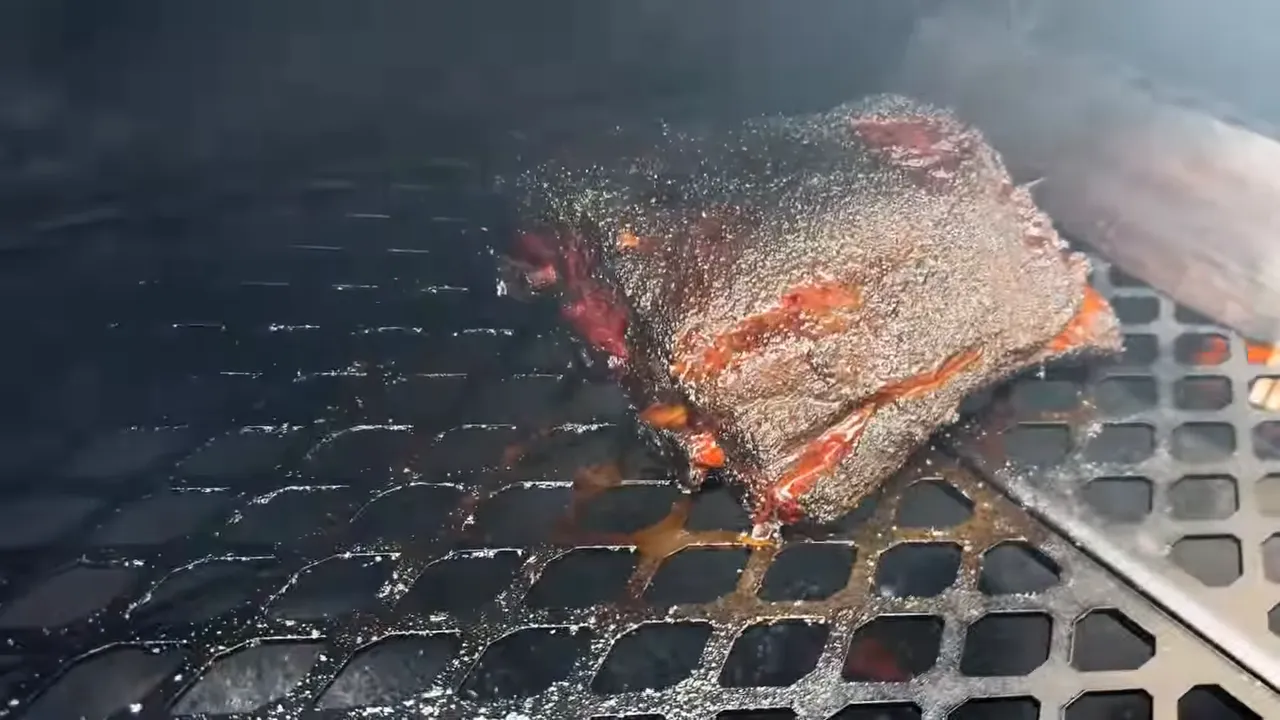
My plan was to wrap the pellet rack at the same stage of bark development, not necessarily at the same internal temperature. That stage took almost the entire cook to arrive.
The Traeger ribs stayed unwrapped until roughly 195°F, when it was time to take them off. By then, their bark looked much closer to the offset rack. The two racks finished within about 15 minutes of each other.
I also noticed a little shredding on the bottom of the pellet-cooked rack. More heat coming from below may have contributed, but that was an observation from this cook, not something I isolated and proved.
The important distinction is that similar-looking finished bark didn’t mean the ribs had cooked the same way. One rack needed paper protection much earlier; the other needed nearly the whole cook exposed to build its exterior.
The overnight hot hold
Before holding, I added a little leftover beef tallow from a brisket trim to the bottom of each package and labeled the foil so I wouldn’t mix the racks up.
My oven allows a temperature adjustment that lets me hold around 150°F. That’s a feature worth checking in your owner’s manual, not something to assume every oven can do.
I kept the beef above 140°F throughout the hold. During my first attempts with this oven setup, I left a probe in the meat to verify that it stayed hot enough. An oven’s displayed setting isn’t a substitute for checking the food temperature. The USDA’s hot-holding guidance provides useful context for that 140°F minimum.
The Blind Taste Test: Everybody Picked the Offset
At serving time, the two racks looked remarkably similar. Sarah said that without knowing there were two different cooks, she could easily have assumed they were the same.
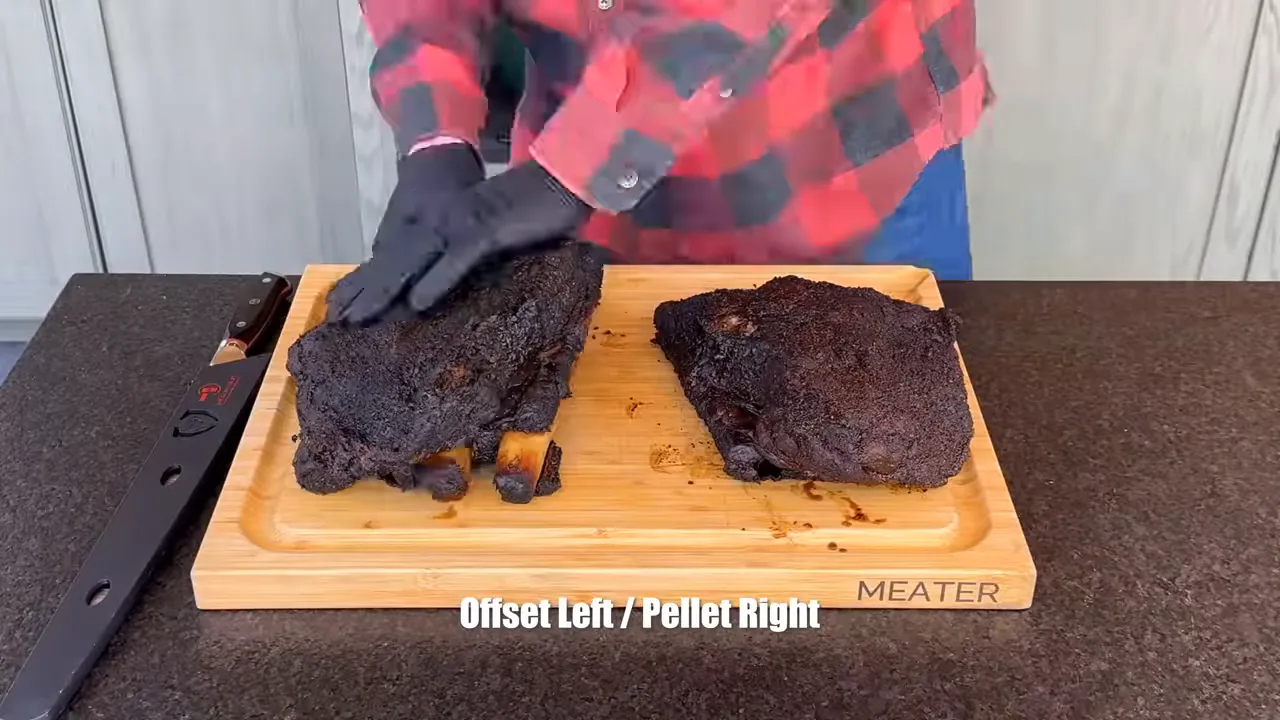
The question was simple: which sample had the better smoke flavor? No explanation of the cookers, no hints about which one I expected to win.
Every invited taster chose the offset ribs.
Sarah’s feedback captured the difference well. Both samples were delicious, but the offset had greater depth of flavor and a little more smoke in a way that suited the beef. The pellet ribs were good; the offset ribs had an extra layer that made them the preferred bite.
That matters. This wasn’t a case of one rack being wonderful and the other being a failure. They were close enough in appearance and both enjoyable to eat, yet the preference consistently went in the same direction.
It also matters not to stretch the result further than the test supports. This comparison shows that friends and family could taste and prefer the offset’s flavor on these beef ribs, with these setups. It doesn’t establish that every offset cook will beat every pellet cook.
Which Smoker Would I Choose?
For this cook, the offset delivered the flavor I was chasing: stronger depth, satisfying smoke, and bark that developed early and confidently.
That lines up with what draws me to Texas-style offset barbecue. But a conversation with Aaron Franklin also reinforced the other side of the equation: an offset gives you plenty of opportunity to mess things up.
A cooker with a higher flavor ceiling still needs someone willing to manage it. If you aren’t available, attentive, and interested in learning the fire, the potential doesn’t automatically turn into better dinner.
- Choose a pellet grill when convenience and minimal interaction are the priorities. It can produce excellent food without asking you to make fire management the day’s main activity.
- Consider an offset when you want that deeper wood-fire profile and can be present for fuel additions and adjustments.
- Count all the work when comparing ownership, including pellet ash cleanup, but don’t confuse comparable hands-on minutes with comparable freedom.
The Trillium prototype’s insulated firebox has helped extend the time between wood additions in my testing, and I’ve sent Smoke North some design tweaks for the production version. Even so, insulation and a bundled fire don’t turn an offset into a completely hands-off cooker.
My takeaway is simple: yes, the smoke difference was noticeable enough for everyone in this test to prefer the offset. Whether it’s worth managing that fire depends on your schedule and what you enjoy about barbecue.
There’s room for both teams. Don’t be afraid to fire it up.
A Smart-Control Option for an Analog Smoker
ChefsTemp sponsored this comparison, and its smart-grill system addresses a related problem: sometimes I’d rather spend time with friends and family than tend a smoker.
I previously used the ProTemp S1 to help turn my Weber Smokey Mountain into a digitally monitored, fan-controlled setup. The S1 provides a large digital display and, when paired with the optional fan and information from up to four independent wireless probes, can take over temperature-control duties on compatible grills and smokers.
I originally became a ChefsTemp customer through the X10 instant-read thermometer, which impressed me with its performance, quality, and value. The promoted offer includes savings of up to 25% with code SDBBQ; check the current terms for the products you’re considering.
|


