A backyard offset smoker and a gravity-fed charcoal smoker look like very different ways to make barbecue. But put ribs from each one on the cutting board, and the differences can be a whole lot smaller than you expect.
That is not me saying the offset is going anywhere. I have traveled around the country, visited nearly half of Texas Monthly’s top 50 barbecue restaurants, and had opportunities to eat with and cook alongside outstanding pitmasters. There is a reason the offset is so closely associated with that signature Texas barbecue flavor.
The catch? A backyard offset is not simply a restaurant-sized offset made more convenient. Shrinking the cooker changes the fire management, airflow, and amount of cooking space you can comfortably use.
To put those tradeoffs into perspective, I compared the Old Country G2 offset smoker with the Masterbuilt Gravity XT, cooking two racks of St. Louis ribs in each and checking heat patterns and exhaust airflow along the way. Both manufacturers supplied these smokers at no cost. My goal is to give you enough practical information to decide which approach fits your backyard, rather than declare a winner based on my taste buds.
Key Takeaways
- Small backyard offsets can require more demanding fire management than much larger restaurant pits.
- The Gravity XT offered more useful cooking capacity despite occupying less backyard space.
- Both smokers produced good bark, with rib flavor differences smaller than expected.
- The XT combines charcoal-and-wood cooking with automation and high-heat grilling versatility.
Table of Contents
- Why Smaller Offset Smokers Can Be Harder to Run
- Cooking Capacity: Measure the Useful Space, Not Just the Grate
- How I Set Up Each Smoker for the Rib Test
- What the Thermal Camera Revealed
- Airflow: An Offset Advantage, With a Measurement Caveat
- Bark, Smoke Ring, and Flavor: Closer Than Expected
- Which Smoker Makes More Sense for Your Backyard?
- The Bottom Line
Why Smaller Offset Smokers Can Be Harder to Run
Usually, smaller means easier. Parallel parking a Mini Cooper is a little less intimidating than parking a transport truck. Backyard offsets have a funny way of turning that logic upside down.
A large restaurant offset has a generous firebox and cooking chamber. There is room to build a clean-burning wood fire and room for the hot gases to settle into a more manageable flow before passing across the food. Those proportions give the person managing the fire some breathing room.
On a small offset, that margin gets tighter. Even experienced pitmasters can find a backyard cooker surprisingly demanding.
Three details become especially important:
- Firebox insulation: An uninsulated, partially insulated, or fully insulated firebox changes how much fuel you need to maintain temperature.
- Wood split size: The fire needs enough burning wood to stay healthy without sending the cooking chamber far above your target.
- Coal-bed maintenance: Fresh splits need a strong enough bed of coals to ignite and keep burning.
The G2 has a fully insulated firebox. That helps retain heat, but it also means you cannot keep piling in wood at a low smoking temperature without consequences. You have to balance the heat you need against the fire you can sustain.
The Flavor Gap May Be Smaller Than the Name Suggests
Two common complaints come up around backyard offsets: keeping the fire going takes more work than expected, and the flavor is not always dramatically different from other charcoal smokers.
My hypothesis is that those complaints can be connected. If a small offset relies heavily on charcoal to maintain its coal bed, with a wood split added for flavor, its fuel arrangement begins to resemble other backyard charcoal cookers.
That is different from a large offset running on a sustained wood fire with strong convection airflow. Owning the offset shape does not automatically recreate the same cooking conditions.
Even the restaurant world continues to explore other cooker formats. A Texas Monthly article I recently read discussed alternatives gaining ground, which is a useful reminder that barbecue equipment keeps evolving. The offset has earned its reputation, but it is still worth asking what problems another design might solve.
Cooking Capacity: Measure the Useful Space, Not Just the Grate
The first surprise in this comparison is how much patio space a smoker occupies versus how much comfortable smoking space it provides.
Old Country G2: About 352 Square Inches in My Preferred Cooking Zone
The G2 is a direct-flow offset. Heat enters from the firebox, passes through the cooking chamber, and exits through the collector and stack. In practice, that creates an arcing heat pattern with a hot area near the firebox and another near the collector.
You can fill more of the grate and move food around as needed. But for brisket, ribs, and similar long cooks, I prefer to avoid those hotter ends.
My useful central cooking zone measures approximately:
- 22 inches wide, leaving space at both ends.
- 16 inches front to back.
- 352 square inches of preferred smoking space.
That is the reality behind a cooker occupying roughly six feet of backyard space. For context, a Kamado Joe Big Joe or extra-large Big Green Egg provides more than 400 square inches on its main cooking surface. A physically larger smoker does not necessarily give you more usable room for low-and-slow barbecue.
Masterbuilt Gravity XT: More Space in a Smaller Footprint
The Gravity XT is a little over four feet wide with its shelf extended and just over three feet with the shelf folded. Its multiple cooking levels make a substantial difference.
- Primary cooking grate: Approximately 460 square inches.
- Total cooking area across the racks: Approximately 1,260 square inches.
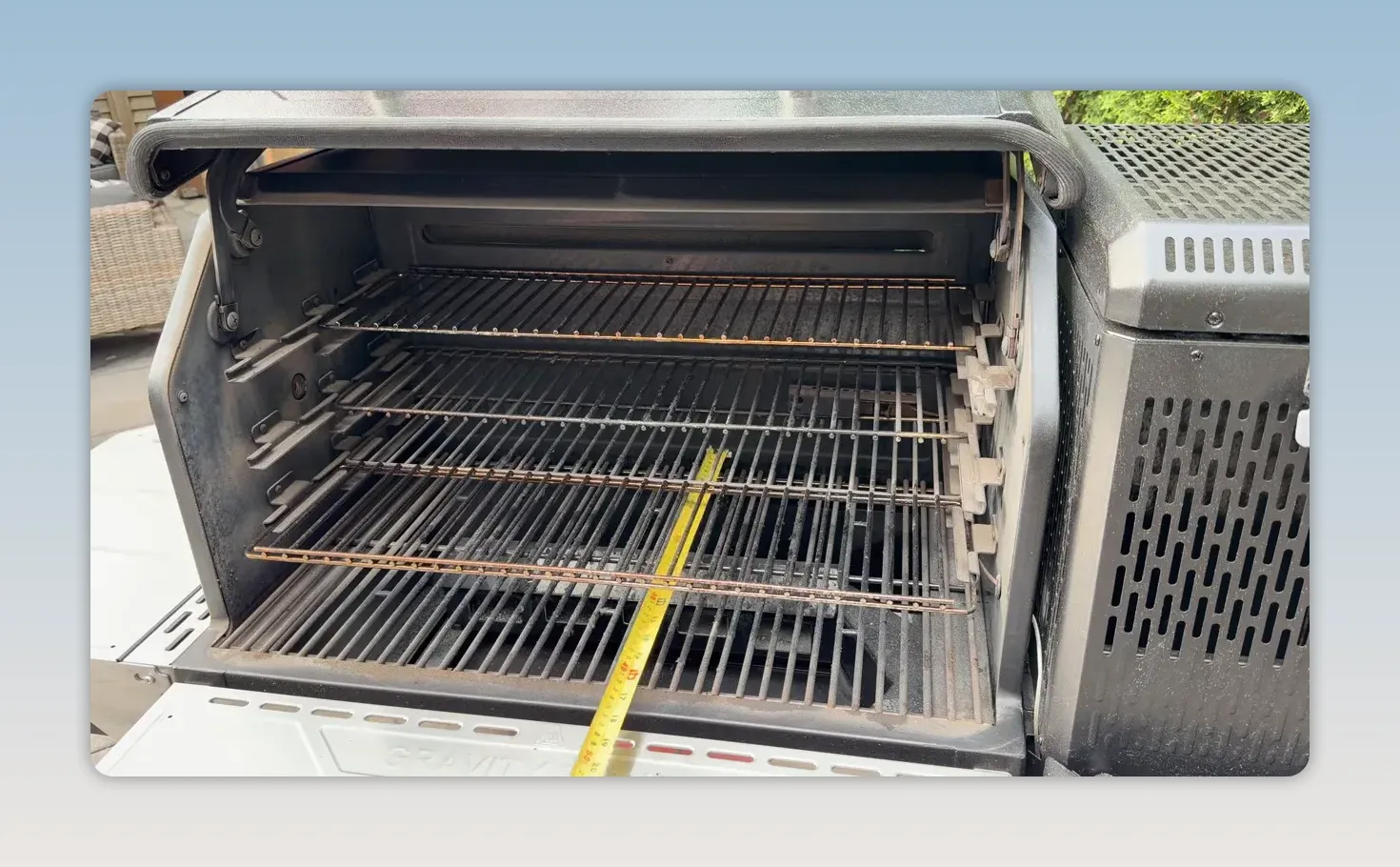
These numbers compare my preferred usable smoking zone on the G2 with the XT’s grate area, not two manufacturers’ advertised capacity figures. That distinction matters. The question is not simply how much metal grate exists, but where I am comfortable leaving food for a long cook.
I have also loaded the XT with ribs in a separate maximum-capacity cook, and the results held up across the racks. The extra levels are not just there to make a specification sheet look impressive.
The Prices Were Almost Identical
At the time of this comparison, the G2 was approximately $1,750 US, while the Gravity XT was approximately $1,799 US. That puts them within about $50 of each other.
With purchase price that close, useful capacity, fire management, and everyday convenience become much more meaningful buying considerations.
How I Set Up Each Smoker for the Rib Test
I cooked two racks of St. Louis ribs in each smoker. That gave me a practical look at how much room a normal backyard cook occupies, while leaving enough space to examine the heat patterns.
This was not a fuel-consumption study with weighed fuel totals. The fuel observations are about how each cooker needed to be managed during the cook.
G2 Setup: Charcoal Bed, Then Wood Splits
For the offset, I started with a small charcoal bed, lit it with a torch, and added a wood split.
To hold approximately 260°F in this fully insulated firebox, I generally needed one split at a time, occasionally two while trying to maintain the coal bed. Adding too much wood would send the temperature much higher than I wanted.
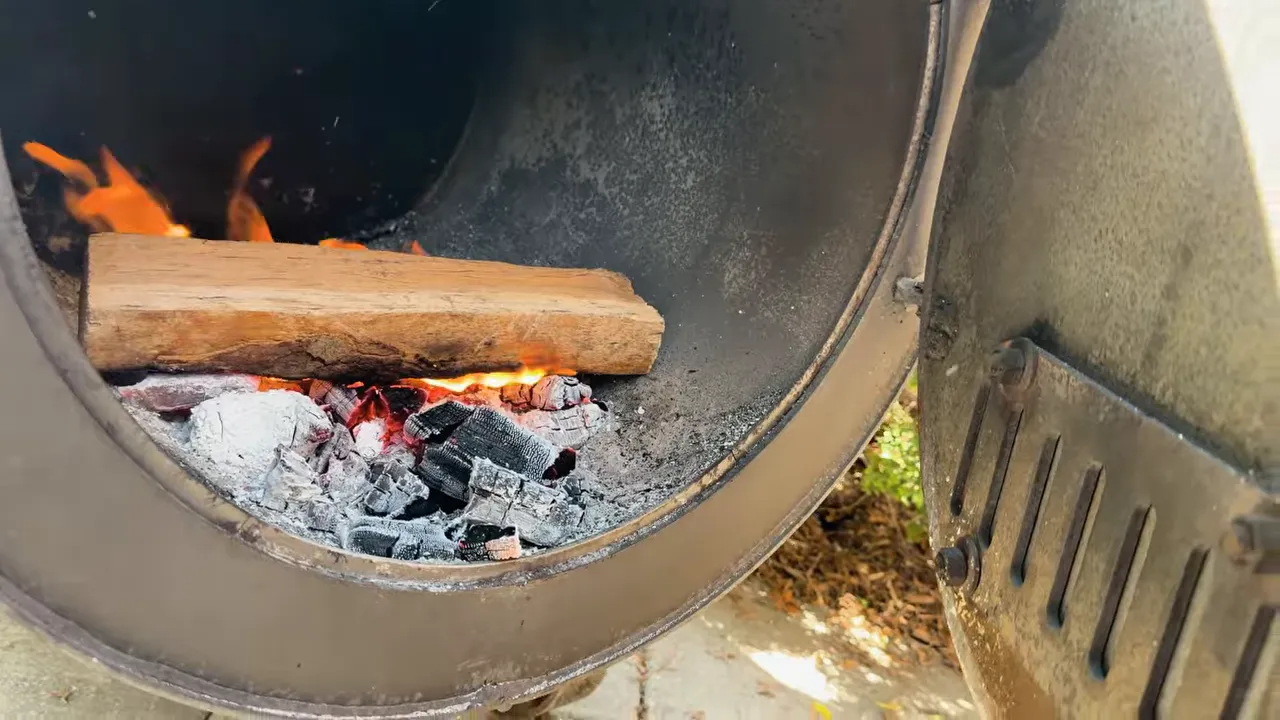
Here is the balancing act: burning so few splits does not always replenish the coal bed fast enough. I needed to supplement it with charcoal during the cook. Otherwise, I would eventually reach a point where a fresh split struggled to combust.
That is not a universal fuel schedule for every offset. Firebox size and insulation change the equation. It is how this cooker behaved at this target temperature.
Gravity XT Setup: Layered Lump Charcoal and Wood
The Gravity Series gives you fuel choices. Briquettes are an option, but I personally prefer the flavor I get from natural lump charcoal.
I have previously experimented with running gravity smokers on full wood splits, effectively treating them more like an offset. That was not the approach here. For this comparison, I used the normal charcoal-and-wood method described in the manual:
- Add natural lump charcoal.
- Light it with a fire starter.
- Add wood and more charcoal in layers through the hopper.
- Let the grill’s automatic temperature control manage the fire.
That is a more representative comparison for someone buying a gravity-fed smoker for its everyday convenience, rather than trying to turn it into a different kind of cooker.
What the Thermal Camera Revealed
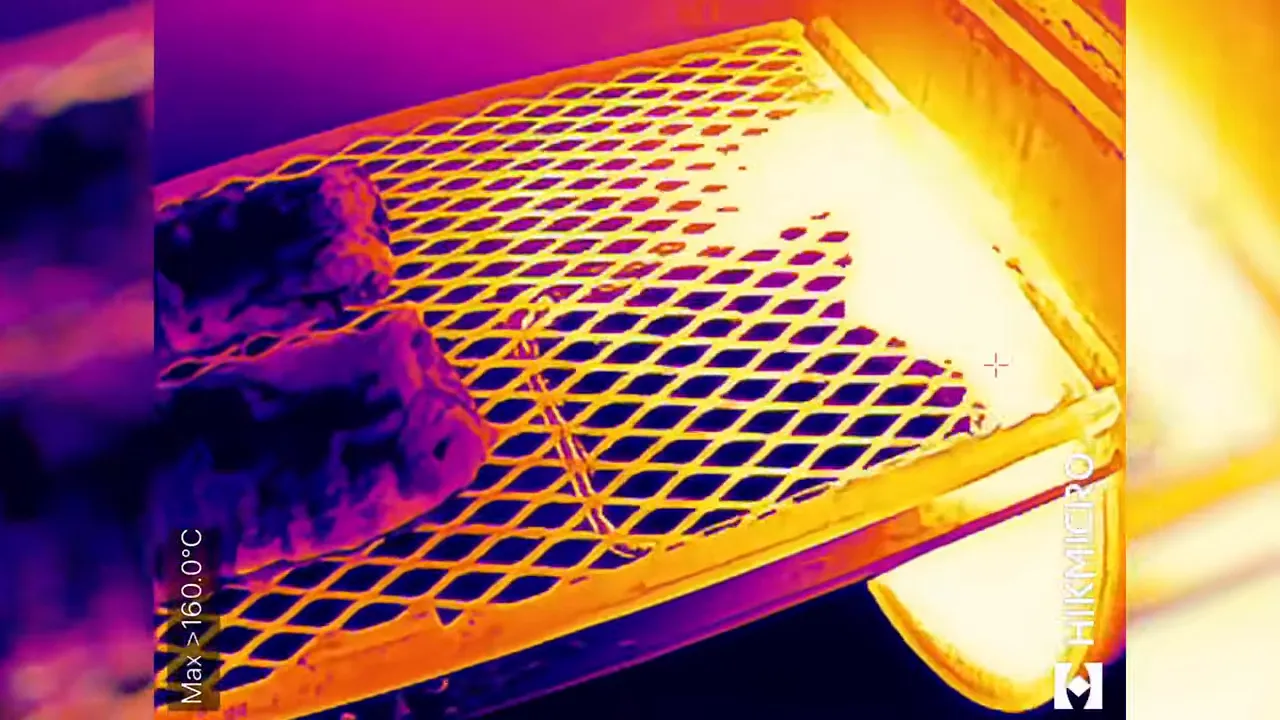
A thermal camera helps make heat patterns visible instead of leaving us to guess from the outside. I used it to examine the cooking zones and check whether the placement advice matched what was happening inside.
The Offset’s Hot Spots Were Easy to See
On the G2, the thermal images showed the insulated firebox walls retaining heat, while the front and end plates appeared much hotter. Inside the cooking chamber, the areas near the firebox and collector stood out.
The ribs were positioned in the central zone between those hotter areas, which is exactly why I use a smaller capacity figure than the full grate dimensions might suggest.
The XT Had a Broad Cooking Zone, With One Placement Consideration
The Gravity XT also showed a good cooking area. The main thing to keep in mind is the heat entering around its distribution baffles. For a long cook, I do not want a sensitive piece of meat sitting directly above that incoming heat unnecessarily.
When I am cooking one brisket, my favorite position is the second cooking level. That adds separation from the heat below and helps keep the bottom from drying out. In my experience, this placement removes the need to reach for a foil boat simply to manage bottom heat.
The thermal results supported the XT’s usefulness across its racks, and my previous fully loaded rib cooks backed that up in practice. Neither cooker failed the heat-pattern test. They simply require different placement decisions.
Airflow: An Offset Advantage, With a Measurement Caveat
Convection airflow is part of what makes an offset special, so I also used an anemometer to compare the exhaust leaving each cooker.
The offset produced the higher exhaust-speed reading. But there is an important limitation: the two exhaust designs are not equally easy to measure.
On the G2, I could position the instrument directly above a concentrated chimney outlet. The XT releases exhaust through a wide opening across the back, spreading that flow over a much broader area.
A reading taken at one part of that wide opening is not directly equivalent to a reading above the offset’s stack. Exhaust velocity at the measuring point is also not the same thing as total airflow through the entire cooker.
My takeaway is that the offset showed stronger airflow at the measured outlet, consistent with what I expected. I would not use that result alone to declare a precise overall convection advantage or choose a winner.
Bark, Smoke Ring, and Flavor: Closer Than Expected
Both smokers produced ribs with good bark and a visible smoke ring. If I had to pick strictly on the appearance of the smoke ring, I would give the offset a slight edge.
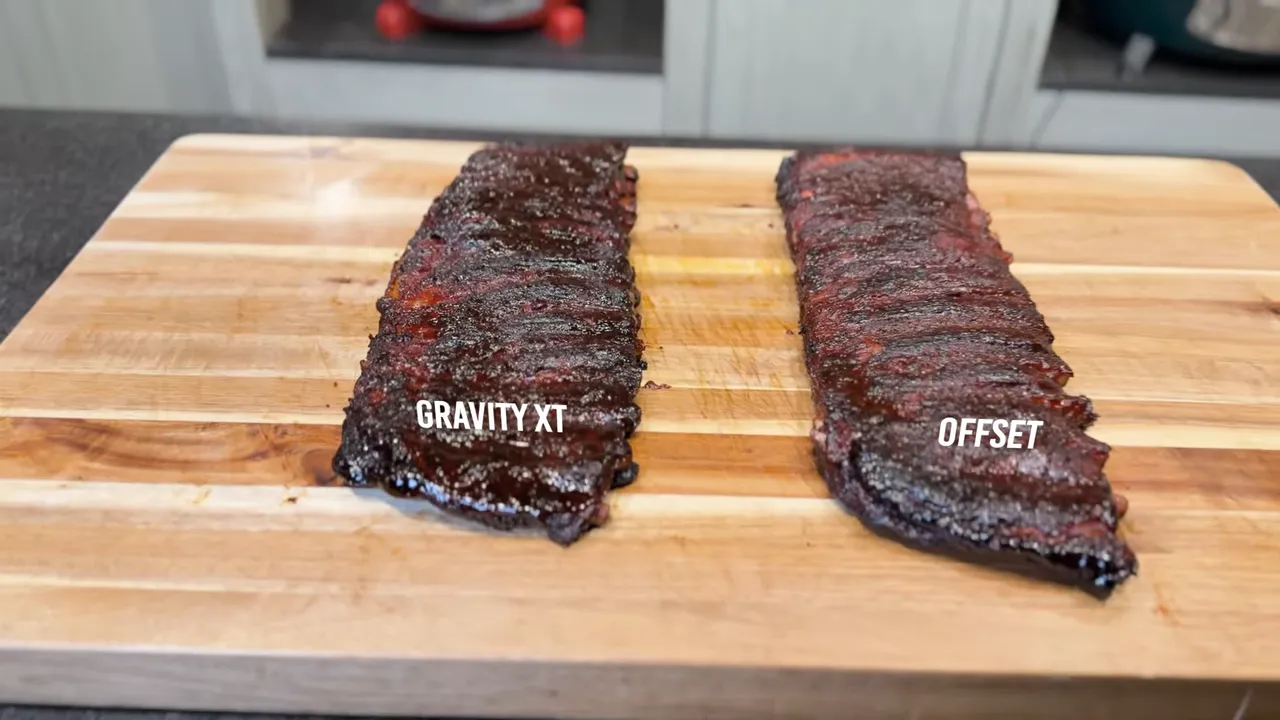
Flavor was close, too. I have done plenty of side-by-side rib comparisons where the differences jump out immediately. This one was more about splitting hairs.
I suspect that if I served these ribs to a group, preferences could divide pretty evenly. That is an impression, not the result of a blind tasting panel.
Taste is a lot like coffee. Some people want a bold, dark profile; others prefer something completely different. My preference is not a universal scoring system, which is why capacity, heat distribution, and the amount of work required deserve just as much attention.
Which Smoker Makes More Sense for Your Backyard?
Choose the Offset if Managing a Wood Fire Is Part of the Appeal
I still love offsets. A large trailer-mounted offset that I could tow around the country for massive cooks is very much on my wish list.
If you want the hands-on process of managing a fire, learning how split size affects combustion, and building your skills around a traditional offset, those are good reasons to own one.
Just buy with realistic expectations. A backyard offset can demand more attention than a much larger cooker, and its most comfortable low-and-slow cooking zone may be smaller than its overall dimensions imply.
Buy it because you want the offset process, not because you assume the shape guarantees a dramatic flavor upgrade.
Choose the Gravity XT if You Want Charcoal Flavor With Automation
For most people looking for a practical backyard smoker, the Gravity XT makes a strong case. I think of it as charcoal and wood’s answer to the pellet grill.
You get:
- Automatic temperature control instead of manually feeding individual splits throughout the cook.
- A digital control panel and Wi-Fi app control, including remote temperature adjustments.
- Ample cooking capacity on the main grate and additional racks.
- Convenience for overnight briskets without the same ongoing fire-management routine.
- High-heat versatility, including steak searing at temperatures up to approximately 700°F.
That last point matters if you want one cooker for brisket, ribs, pulled pork, steaks, and everything in between. The comparison is not only about which machine can smoke ribs. It is about what you need your backyard cooker to do the rest of the week.
The Bottom Line
The offset has earned its place in barbecue. What deserves more scrutiny is the assumption that shrinking one down to patio size preserves every advantage of a large Texas pit.
In this comparison, the Old Country G2 produced excellent ribs and showed the stronger exhaust-speed reading. It also required active coal-bed management and offered less preferred smoking space than its footprint suggested.
The Masterbuilt Gravity XT delivered ribs that were very close in flavor, more useful cooking capacity, automatic temperature control, and the flexibility to move from low-and-slow barbecue to high-heat grilling.
For a dedicated offset enthusiast, tending the fire may be the whole point. For most backyard cooks who want great barbecue with fewer demands on their time, the Gravity XT has brought a serious fight to the backyard offset.
Whatever you choose, do not be afraid to fire it up.


