The Weber Kettle has earned its place in the backyard. It is affordable, straightforward, and capable of turning out fantastic barbecue. But a modern charcoal cooker like the Masterbuilt Gravity Series raises a fair question: how much convenience, capacity, and smoking performance are we giving up to keep things simple?
I put the two head to head with low and slow setups, thermal imaging, airflow measurements, chicken, ribs, and steak. My goal was not to crown the newest grill automatically. It was to find out where each design shines, where it needs help, and which one makes the most sense for the way you cook.
My overall winner was the Masterbuilt Gravity Series, but the Weber Kettle still won an important category: straightforward grilling directly over charcoal.
For transparency, Weber and Masterbuilt supplied the grills used in these tests. I did not purchase either unit. The comparison centers on the 22-inch Weber Kettle and the Masterbuilt Gravity Series 800, including its supplied griddle.
Key Takeaways
- The Masterbuilt Gravity Series won my low and slow tests through heat distribution, airflow, and capacity.
- The Weber Kettle remained the simpler choice for searing steaks directly over charcoal.
- My rib-capacity test fit three racks on the kettle and six on the Masterbuilt.
- Adding automation and indirect-cooking accessories can bring a kettle's total cost close to the Gravity Series.
Table of Contents
- Two Charcoal Cookers With Different Starting Points
- Low and Slow: The Snake Method vs. Gravity-Fed Charcoal
- Heat Distribution: What the Thermal Camera Revealed
- Airflow and Chicken Skin: Did the Difference Show Up in the Food?
- Cooking Capacity: Three Racks of Ribs vs. Six
- Steak Searing: The Weber Kettle Pushes Back
- Versatility and Value: How Much Should You Modify a Kettle?
- Which Charcoal Grill Should You Buy?
- My Verdict: A New Overall Winner, Not an Obsolete Classic
Two Charcoal Cookers With Different Starting Points
Both cookers promise low and slow barbecue and hot and fast grilling. Both also burn charcoal, which is absolutely my preference over pellets for barbecue flavor. Add real smoking wood, and that is the backyard cooking experience I get excited about.
But these grills approach those jobs from opposite directions.
- The Weber Kettle is a grill first. The charcoal sits beneath the cooking grate, making direct cooking wonderfully simple. Turning it into a smoker means arranging the fire and managing the airflow to suit that job.
- The Masterbuilt Gravity is a smoker first. Its fire lives in a vertical hopper beside the cooking chamber. A digitally controlled fan manages airflow and feeds heat into the cooker. On the 800, the included griddle adds another useful cooking surface.
Think of the Masterbuilt as Team Charcoal's answer to the pellet grill: digital temperature control, but with a choice of charcoal fuels and smoking wood. Its separate fire location also gives it something in common with an offset smoker, although the designs are not identical.
Those starting points explain a lot of what happened in the tests. Each cooker can stretch into the other's territory, but stretching usually involves a compromise.
Low and Slow: The Snake Method vs. Gravity-Fed Charcoal
Why the Weber Kettle snake method works
The snake method is a clever way to get hours of steady heat from a simple kettle. Instead of lighting a whole pile of charcoal, you arrange briquettes around the outside of the charcoal grate. Light one end, and the fire gradually works its way around the ring like a slow-burning fuse.
My setup used:
- Briquettes arranged two by two around the outer edge.
- A water pan in the middle.
- Smoking wood chunks spaced along the charcoal.
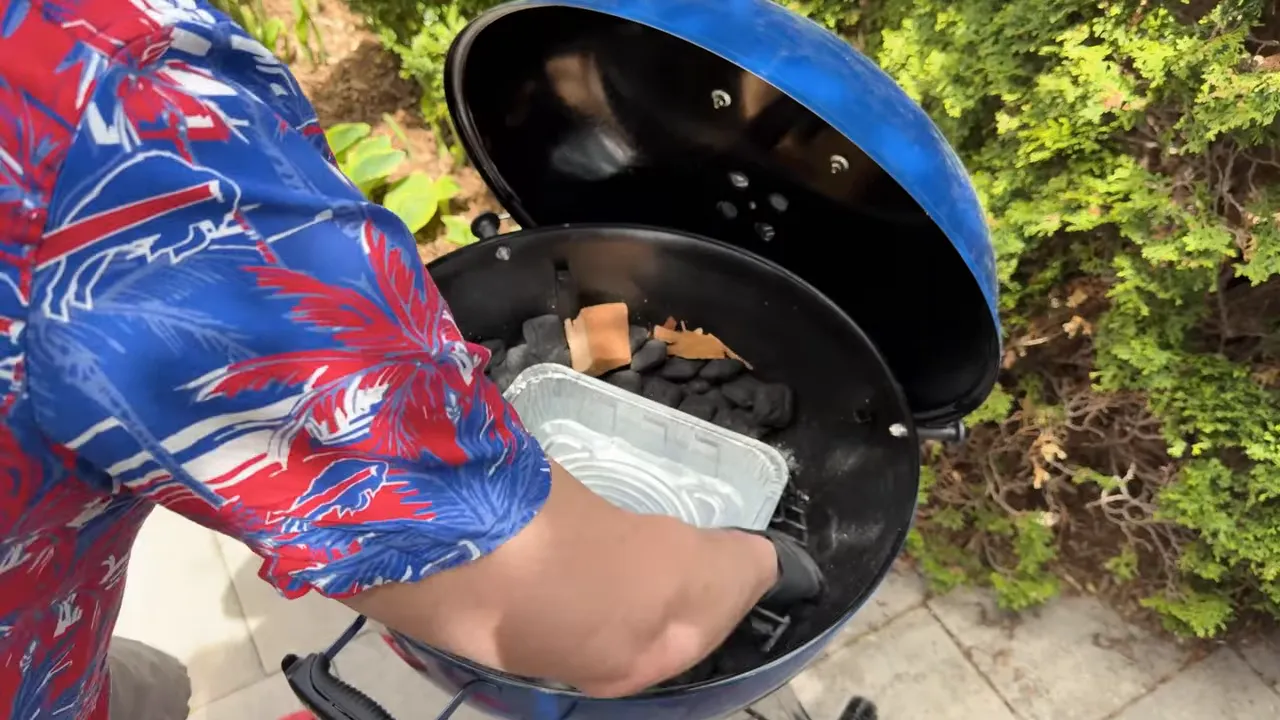
In my experience, starting with the vents open and then reducing them to roughly halfway once the cooker settles can produce a steady cook around 250°F. That settling period can take about an hour to an hour and a half. Treat those vent positions as a starting point, not a guarantee for every fire and set of conditions.
The method works incredibly well. Its consistency, however, depends heavily on the uniform shape and predictable burn of briquettes.
The fuel trade-off
Briquettes have real strengths: consistency, predictability, and long burn times. They are processed into a uniform shape, and they tend to leave more ash. For my taste, natural lump charcoal gives me a cleaner, more appealing charcoal flavor, along with the ability to burn very hot.
That is a preference, not a reason to dismiss everyone who enjoys cooking with briquettes. The practical issue is that irregular pieces of lump are harder to arrange into a reliably progressing snake.
The limitation is not that a kettle cannot burn lump charcoal. It certainly can. The limitation is using lump in this particular low and slow setup.
The Masterbuilt solves temperature control differently. Charcoal feeds downward through its vertical hopper, while the controller and fan regulate the fire's air supply. It does not need a chain of similarly shaped briquettes touching one another to maintain a controlled burn.
That gives me more flexibility. I can choose briquettes for their predictable, extended burn, or use natural lump charcoal with smoking wood for the flavor profile I prefer. The automation handles the airflow rather than asking the fuel arrangement to do all the work.
Heat Distribution: What the Thermal Camera Revealed
A temperature reading of 250°F does not tell you whether every part of a cooking grate is receiving the same heat. To investigate that, I set both grills up for low and slow cooking and examined their heat patterns with an infrared camera and an infrared temperature gun.
The kettle used the snake setup with wood and a water pan. For the first comparison, I left the Masterbuilt's griddle installed and put a separate cast-iron griddle inside the kettle. I allowed the kettle setup to heat soak for more than an hour before checking it.
These tools show surface temperatures and heat patterns, rather than directly measuring the air throughout the chamber. The solid surfaces made those patterns easier to see. I also repeated the inspection with the griddles removed.
The kettle had a concentrated hot spot
As expected, the kettle showed a strong hot spot wherever the snake was actively burning. That happened both with the griddle in place and with it removed.

This does not make good kettle barbecue impossible. It does mean the fire's location is something you have to account for, especially when food occupies most of the grate.
The Masterbuilt spread heat more evenly
The Masterbuilt's thermal images showed a more even heat pattern across the cooking area. I was impressed with the distribution both with the griddle installed and in the regular smoking configuration with it removed.
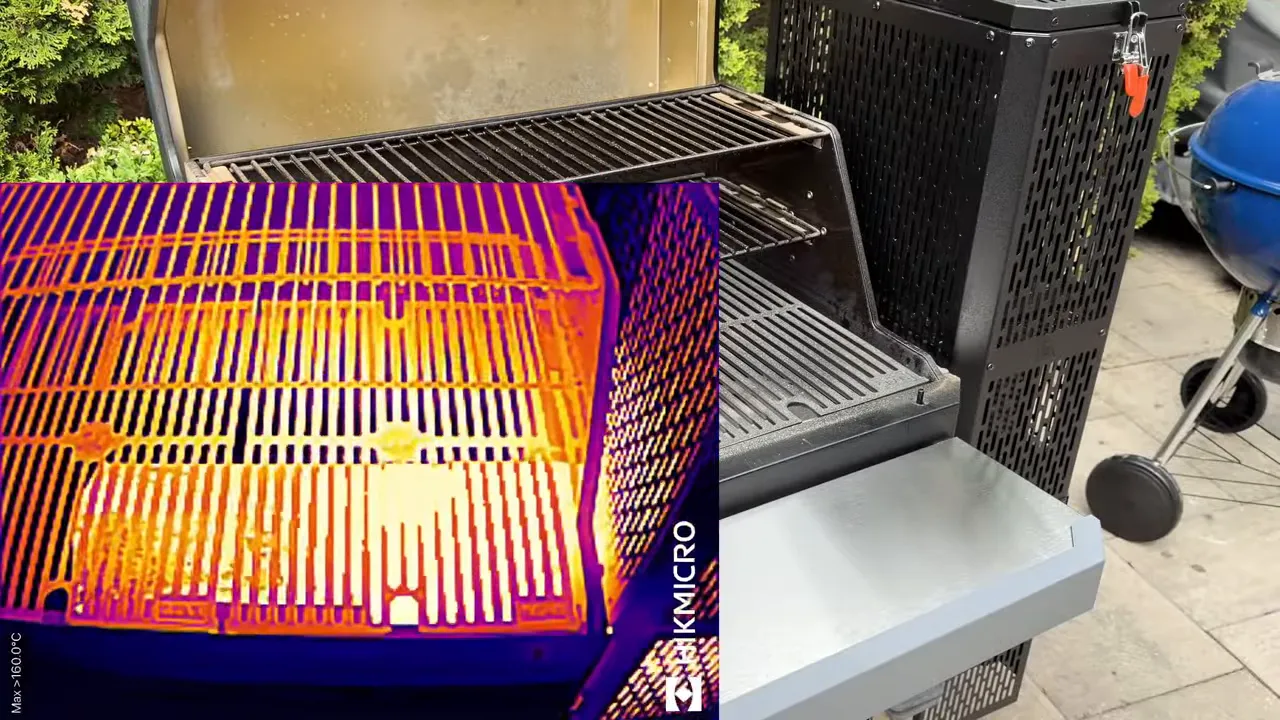
That result fits the design. The kettle is controlling a fire directly beneath part of the food. The Gravity Series is moving heat from a separate fire into the cooking chamber.
For low and slow smoking, the advantage in this test went to the Masterbuilt. But I wanted more than thermal images before drawing a conclusion.
Airflow and Chicken Skin: Did the Difference Show Up in the Food?
Before getting into airflow measurements, it helps to separate the three ways heat reaches food. These are the basic heat-transfer mechanisms at work in both cookers:
- Conduction: Heat transfers through direct contact, such as a steak touching a hot griddle.
- Convection: Moving hot air transfers heat around the food and carries moisture away from its surface.
- Radiation: Energy travels from hot coals and heated surfaces to the food without requiring direct contact.
All three matter, but their balance changes how a cooker performs. For smoking, I am particularly interested in convection. Moving smoky air helps manage surface moisture, which matters for bark development on ribs and brisket and for drying chicken skin.
The airflow measurements
With both grills operating at the same temperature, I used an anemometer to check the air leaving each cooker.
At the kettle's exhaust, the airflow was too low for the instrument to register a useful flow reading in my setup. That does not mean the kettle had no airflow. It means I could not meaningfully measure it with that instrument and placement.
At the Masterbuilt, I could consistently register air movement. Its fan-driven design and larger chamber produced a clear difference in this test.
The chicken comparison
To see whether that difference mattered at dinner, I seasoned chicken halves, let them sit in the refrigerator, and cooked them on the two grills at the same cooking temperature.
A little less than 45 minutes later, the results gave me a useful answer. The chicken from the kettle was cooked, but its skin had not developed the crispness I wanted. I would not call it outright rubbery, but it was not where I wanted it to be.
The chicken from the Gravity Series had crispier, more developed skin when cooked through.
That result was consistent with the airflow advantage I had measured. It was a practical cooking result supporting the heat and airflow observations, rather than just a number on a screen.
Cooking Capacity: Three Racks of Ribs vs. Six
Published cooking-area figures are useful, but I wanted to know what the space meant with actual food. So I loaded both cookers with St. Louis ribs.
- Weber Kettle: Three racks fit in my test.
- Masterbuilt Gravity Series: Six racks fit using its available cooking levels.
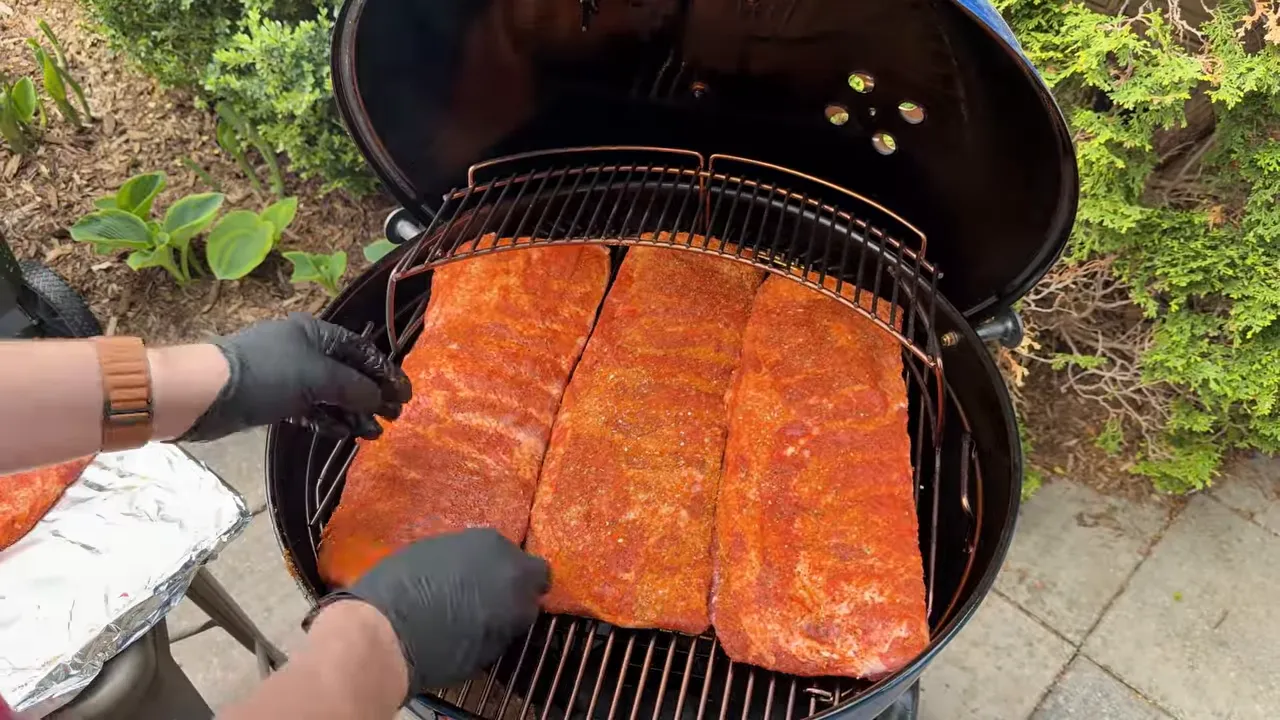
The Masterbuilt offers more than twice the stated cooking area in this comparison, and I could fit exactly twice as many racks of ribs. That is a meaningful difference if you regularly cook for a crowd.
Capacity also interacts with heat distribution. Filling the kettle leaves you less room to keep food away from the active section of the snake. The Masterbuilt combines extra room with the more even heat pattern I observed.
Between fuel flexibility, heat distribution, airflow, chicken skin, and rib capacity, the Masterbuilt Gravity Series won my low and slow comparison.
Steak Searing: The Weber Kettle Pushes Back
Now we are on the kettle's home turf.
There is something special about cooking directly over charcoal. That live-fire flavor is a big part of the appeal of direct-coal barbecue, including Hill Country-style cooking. The kettle delivers it without asking you to modify the grill or invent a workaround.
For this comparison, I used the same natural lump charcoal in both cookers.
The kettle's simple two-zone workflow
I lit the lump charcoal in a chimney and arranged the kettle with the fire toward the front and the lid vent toward the back. That let me start the steak on the cooler side, with airflow passing over it during the indirect portion of the cook.
When it was time to sear, I moved the steak directly over the coals. That was it. From the cool side to the hot side, with no change of equipment.
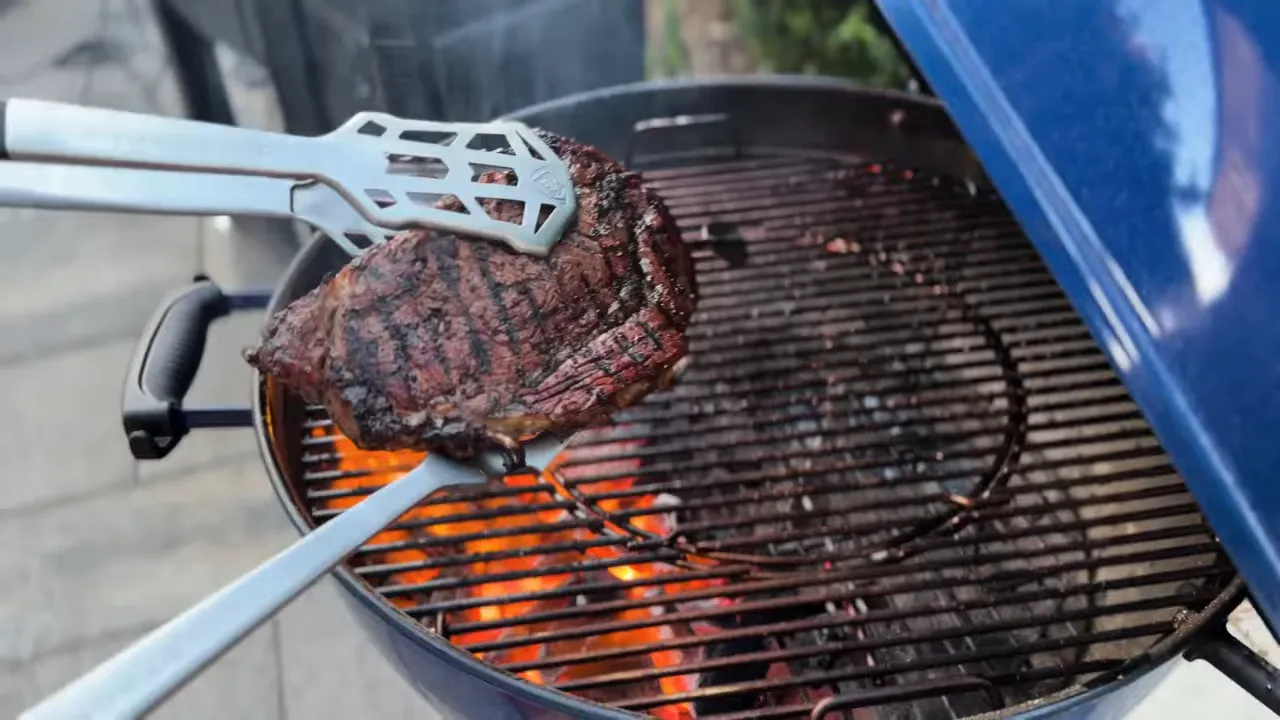
The kettle produced a fantastic sear and the direct-over-charcoal experience it is famous for.
The Masterbuilt can sear, but the experience is different
The first stage of a reverse sear is easy on the Masterbuilt. Set the cooking temperature and let the steak cook indirectly. In my test, the cooker then climbed from low and slow temperatures to 700°F in about two minutes.
The reversible cooking grates offer an option for grill marks, but the fire remains off to the side. A high cooking temperature does not turn that arrangement into the same experience as putting a steak directly above glowing coals.
The Gravity Series 800 does have an excellent alternative: its griddle.
Solid-surface searing has performed very well in my previous steak comparisons, including tests with cast iron, soapstone, conventional grates, and other methods. A hot solid surface gives the steak broad contact with the heat rather than concentrating that contact into narrow grate marks.
With the griddle heated for searing and a little of my sear sauce applied, I turned out an excellent steak on the Masterbuilt.
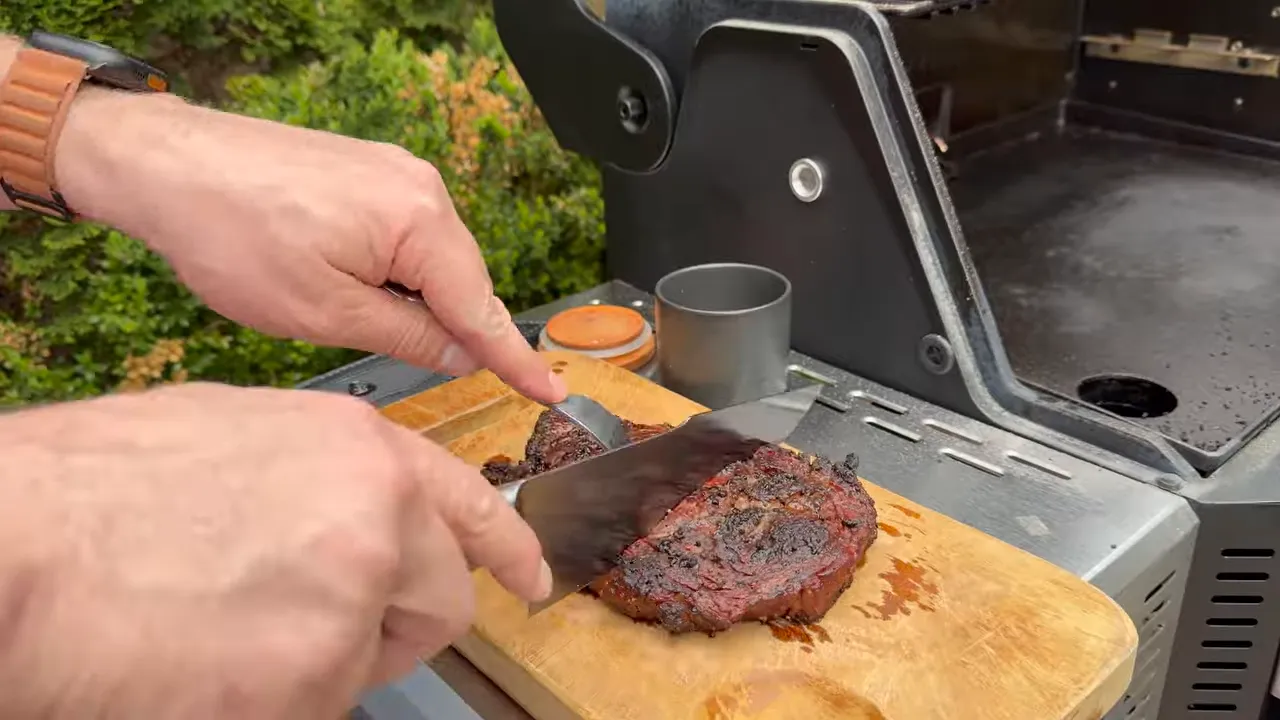
I also experimented with placing a grate over the open charcoal hopper for a direct-fire sear. It worked for a single steak, but it was less intuitive and much more restricted in space than using the kettle. That was an experimental workaround, not a standard cooking setup I would recommend copying; follow the manufacturer's operating instructions.
The important distinction is not whether the Masterbuilt can produce a great steak. It absolutely can. It is whether direct charcoal grilling is the main experience you want.
For easy, direct-over-the-coals steak searing, the Weber Kettle won.
Versatility and Value: How Much Should You Modify a Kettle?
There is a solution for almost every kettle limitation if you are willing to buy accessories.
- A charcoal basket can help organize the fire.
- An indirect diffuser can help shield food from bottom heat.
- A digital fan and controller can automate temperature management and make lump charcoal easier to use on long cooks.
Those are legitimate options. If you already own a kettle and enjoy tailoring it to your cooking, accessories can make sense.
But a fair value comparison needs to include the full setup, not just the starting price. Once you add indirect-cooking accessories and digital control, the kettle can move into roughly the same price territory as the Gravity Series, depending on what you choose.
At that point, some of the simplicity that attracted you to the kettle has disappeared. You have added equipment and cost to reproduce conveniences already built into the Masterbuilt.
And there is still one problem accessories cannot solve: the physical size of the cooking chamber.
No replacement for displacement applies here. A controller does not turn a 22-inch kettle into a cooker that held six racks of ribs in my test.
Wood flavor and the backyard offset comparison
The Gravity Series also gives me options for adding wood flavor. I can supplement charcoal with smoking wood without committing to the constant fire management of a traditional offset.
In earlier experiments, I have also run a Gravity Series on wood splits alone, tending one or two splits at a time. That is a hands-on experiment rather than the automated charcoal experience, and any fuel choice or operating method needs to stay within the manufacturer's guidance.
When I compare its results with an offset, I mean backyard-sized offsets, including my Oklahoma Joe's. I am not claiming this is a replacement for the enormous 500-gallon or 1,000-gallon pits used by barbecue restaurants.
In the blind taste tests I have performed against my smaller backyard offset, the Gravity Series cooking with real wood splits came out ahead each time. That is my testing experience, not a universal promise about every offset or every cook.
For me, the appeal is the range of experiences: convenient charcoal smoking with wood added for flavor, a large cooking chamber, and a griddle for solid-surface searing.
Which Charcoal Grill Should You Buy?
I would not pick a universal versatility winner without first asking what you actually want to cook. The right value for my family may be completely different from the right value for yours.
Choose the Weber Kettle if you want simple charcoal grilling
- Your priority is the lower starting price.
- You love cooking directly over coals.
- You do not need the larger rib capacity.
- You are happy managing vents and arranging the fire yourself.
- You want a straightforward grill without adding digital controls.
For that job, the kettle remains hard to beat. There is a reason this design has stayed beloved for decades.
Choose the Masterbuilt Gravity Series if smoking and capacity come first
- You regularly cook ribs or other barbecue for a larger group.
- You want digital temperature control with charcoal fuel.
- You prefer using lump charcoal for long cooks without building a snake.
- You value more even heat distribution and stronger measured airflow.
- You want the 800's included griddle as another searing option.
The Masterbuilt is especially compelling if your kettle shopping list already includes a diffuser, charcoal-management accessories, and an automatic controller. Compare that complete package with the Gravity Series rather than comparing the Masterbuilt only with a bare kettle.
My Verdict: A New Overall Winner, Not an Obsolete Classic
The Weber Kettle has not suddenly become obsolete. It remains one of the great charcoal grill designs, and it was the easier, more natural tool for direct-coal steak grilling in my tests.
But the Masterbuilt Gravity Series addresses several things kettle owners often want: more room, automated temperature control, flexible charcoal choices for low and slow cooking, and the ability to add wood flavor without fully committing to an offset-smoker routine.
The thermal images favored its heat distribution. The airflow checks showed a measurable difference. The chicken had crispier skin, and the cooking chamber held twice as many racks of ribs.
Taking those results together, my overall winner is the Masterbuilt Gravity Series. The kettle still makes a strong case for simple grilling. The Masterbuilt makes the stronger case when smoking performance, convenience, and feeding more people are part of the same purchase.


