Team pellet or team charcoal? If you are shopping for a new grill and smoker, that decision deserves more than a look at the price tag and a few shiny features.
Every time I put grill fuel economy to the test, the same thing jumps out: over years of regular use, fuel can cost more than the grill itself. But saving money does not mean much if the ribs lack smoke or the steaks come off without a proper crust.
So I put the Masterbuilt Gravity Series XT up against a pellet grill in three backyard tests: fuel cost, smoke flavor, and searing power. I wanted to know which one delivers the goods, from a long weekend smoke session to a quick steak dinner.
Disclosure: Masterbuilt provided free product/sponsorship for this comparison, and Geologie sponsored the original production.
Key Takeaways
- The Gravity XT maintained low-and-slow temperatures for 17 hours, compared with the pellet grill’s 12.5 hours.
- The five-year fuel projection favored the XT by approximately $2,687 at 15 cooking hours weekly.
- Wood splits layered with charcoal produced the stronger rib smoke flavor I preferred.
- The XT exceeded 700°F on cast iron and produced the better tomahawk crust.
Table of Contents
- Setting Up a Fair Pellet vs. Charcoal Comparison
- Test 1: What Does Each Grill Cost to Run?
- Test 2: Which Smoker Makes Better Ribs?
- Test 3: Can They Put a Proper Sear on a Tomahawk?
- The Verdict: Team Charcoal Takes This One
- A Note From My Sponsor
Setting Up a Fair Pellet vs. Charcoal Comparison
At first glance, these grills might not look evenly matched. The Gravity XT offers about 43% more cooking area, with roughly 1,260 square inches versus 884 square inches on the pellet grill.
But cooking area is not the same thing as the volume you have to heat.
The XT uses multiple racks to squeeze more usable cooking space into its chamber. Compare the actual interior volume, and the difference is much smaller: 6.6 cubic feet for the Masterbuilt versus 6.5 cubic feet for the pellet grill. If anything, the XT has a slight disadvantage because its chamber is a little larger.
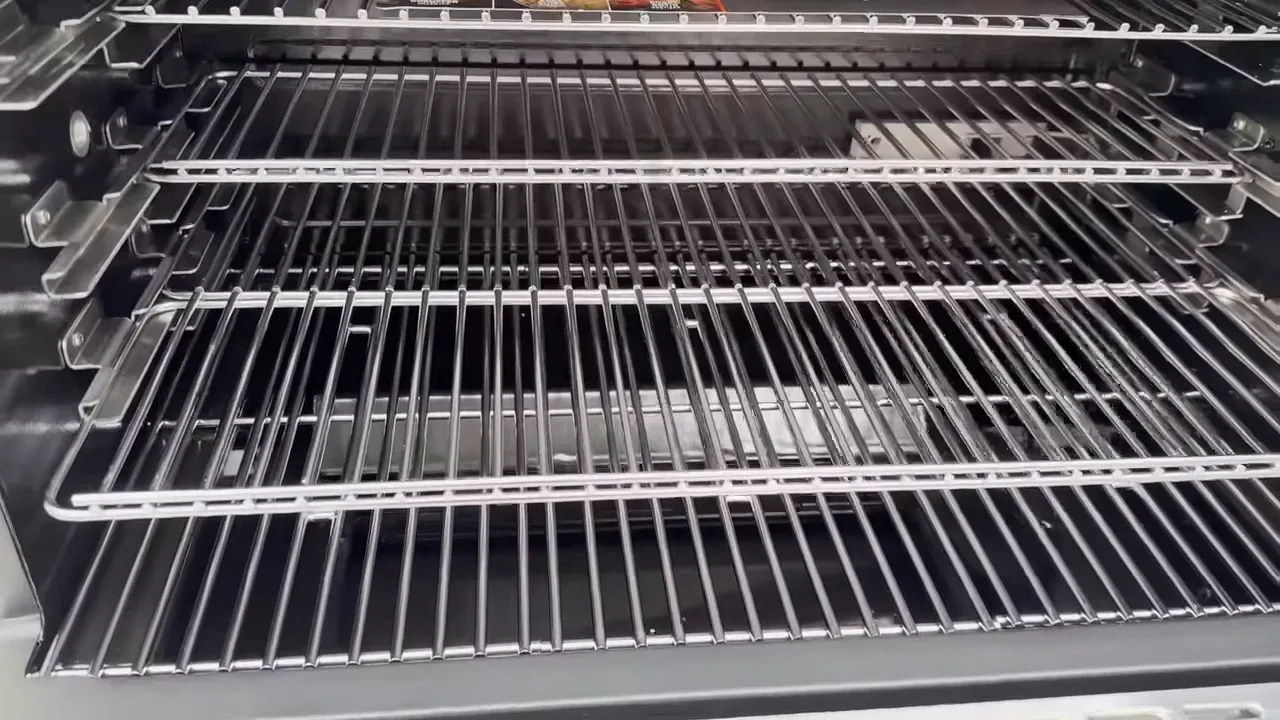
Both grills also have an 18-pound hopper. That gave me a useful starting point for testing how long each could maintain a comparable cooking temperature on a full load of fuel.
The comparison is between these two grills, with these fuels, in my backyard conditions. It is not a promise that every charcoal grill will outperform every pellet smoker by the same margin.
Test 1: What Does Each Grill Cost to Run?
Cars get a fuel economy sticker. Grills? Not so much. Yet the cost of feeding a smoker week after week can make a serious difference to your barbecue budget.
I was particularly interested in whether the XT’s one-piece body construction, thicker steel, and fiberglass gasket would translate into a meaningful difference in operating cost.
The Fuel Economy Method
Here is how I set up the test:
- Fill the pellet hopper to capacity with pellets.
- Fill the Gravity XT hopper to capacity with charcoal briquettes.
- Start both grills and bring them to a low-and-slow cooking temperature of approximately 260°F.
- Place independent temperature probes in comparable locations on the second rack, toward the left side of each grill.
- Monitor the temperatures and adjust the controllers as needed to keep the actual cooking temperatures close.
- Record how long each grill maintains temperature before its fuel supply runs out.
That independent temperature check matters. Each grill places its built-in sensor somewhere different, so matching the controller settings alone would not necessarily mean matching the heat at the cooking grate.
For the completed test, the grills operated within a few degrees of one another.
Why It Took Three Attempts
This was attempt number three, and yes, there was a little frustration involved.
During the earlier attempts, daytime temperatures struggled to reach 50°F and the wind was high. Twice, the pellet grill suffered an overnight flameout. I tried to bring it back, but the resulting temperature gaps meant the runs were no longer fair comparisons. I discarded them.
The Gravity XT continued running through those nights, but I did not use those interrupted attempts to calculate the head-to-head fuel results.
The successful test began in milder conditions, with daytime temperatures in the low to mid-60s and a chilly night ahead. Weather is part of the real-world operating picture, and those earlier problems are worth noting separately from the completed fuel test.
Fuel Prices and Full-Hopper Runtime
I bought both fuels at Home Depot and used available quantity discounts rather than specialty-store pricing:
- Charcoal briquettes: Two 16-pound bags, 32 pounds total, for US $17.88. That works out to about $0.56 per pound.
- Pellets: A discounted price of US $17.96 per 20-pound bag after buying the qualifying quantity, or about $0.89 per pound.
Both grills were up to temperature when the clock started at approximately 5:30 p.m.
- Pellet grill: Ran out of fuel around 6:00 a.m., giving it approximately 12 hours and 30 minutes of runtime.
- Masterbuilt Gravity XT: Maintained temperature for approximately 17 hours before the temperature began dropping.
The pellet hopper was effectively empty when I checked it. This was not a case of a substantial pile of pellets being left behind where the auger could not reach them.
The XT delivered about four and a half additional hours from a full hopper. At the prices used, the resulting fuel costs were approximately $0.59 per hour for the Gravity XT and $1.28 per hour for the pellet grill.
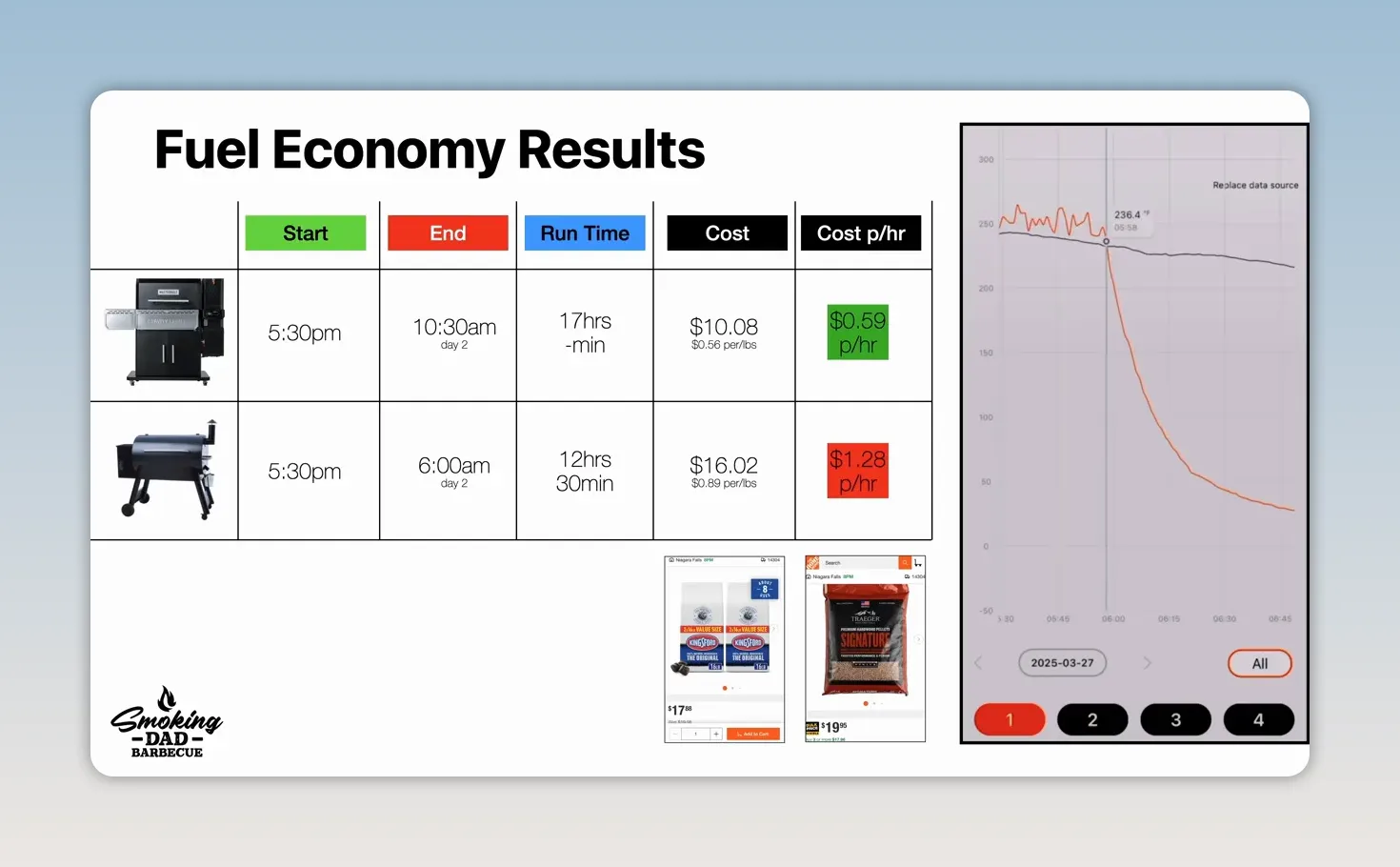
I chose 260°F as a useful middle ground for low-and-slow cooking. Running nearer 200°F could stretch the fuel farther, while hotter cooking would use it faster. The XT’s construction is consistent with the efficiency advantage I was looking for, though this test does not isolate how much each individual feature contributes.
What That Means Over Five Years
To make the hourly difference useful, I modeled a regular cooking schedule:
- One 12-hour smoking session each week.
- Two 90-minute weeknight cooks.
- A total of 15 cooking hours per week.
Using the measured low-and-slow operating costs across that schedule, my five-year fuel estimate came to:
- Pellet grill: US $4,999.80.
- Masterbuilt Gravity XT: US $2,312.70.
- Estimated difference: US $2,687.10 in favor of the XT.
Boy oh boy, that adds up. We are talking about nearly $2,700 in fuel alone.
There is an important distinction here: this is a projection based on the 260°F test, not a measurement of five years of mixed-temperature cooking. The weeknight chicken and steak sessions would not necessarily burn fuel at the same rate. It is also a fuel-cost comparison, not a complete ownership-cost calculation including purchase price, maintenance, and electricity.
To adapt the comparison to your own backyard, use this formula:
Fuel cost per hour = full-hopper fuel cost ÷ hours of runtime.
Then multiply that hourly figure by your expected cooking hours. Your local fuel prices and how often you cook will determine how big the savings become.
A Backyard Difference I Was Not Measuring
Noise was not one of the three formal tests, but it was hard to ignore. The pellet grill was noticeably loud beside me, while the Gravity XT was much quieter to my ears.
That is an observation, not a decibel measurement. Still, if your grill sits close to the spot where friends and family gather, operating noise belongs on your shopping checklist.
Test 2: Which Smoker Makes Better Ribs?
Fuel savings are great. Now for the question that really matters: how does dinner taste?
I used St. Louis ribs and kept the seasoning identical on both racks: a simple combination of salt, pepper, and garlic. No sauce to cover up the differences. I wanted the smoke to have nowhere to hide.
Giving Both Grills a Chance to Produce Smoke
For the Gravity XT, I layered real wood splits among the charcoal inside the hopper. As the fuel burns down, those layers provide smoke without constant attention.
For the pellet grill, I went beyond its normal setup and added a supplemental pellet tube inside the cooking chamber. A common criticism of pellet smokers is mild smoke flavor, and adding a smoke tube is a frequently suggested workaround. I wanted to give that approach a fair chance rather than leave an obvious objection hanging over the result.
That means this was a comparison of charcoal plus wood splits versus pellets plus a supplemental pellet tube, not simply two untouched factory setups.
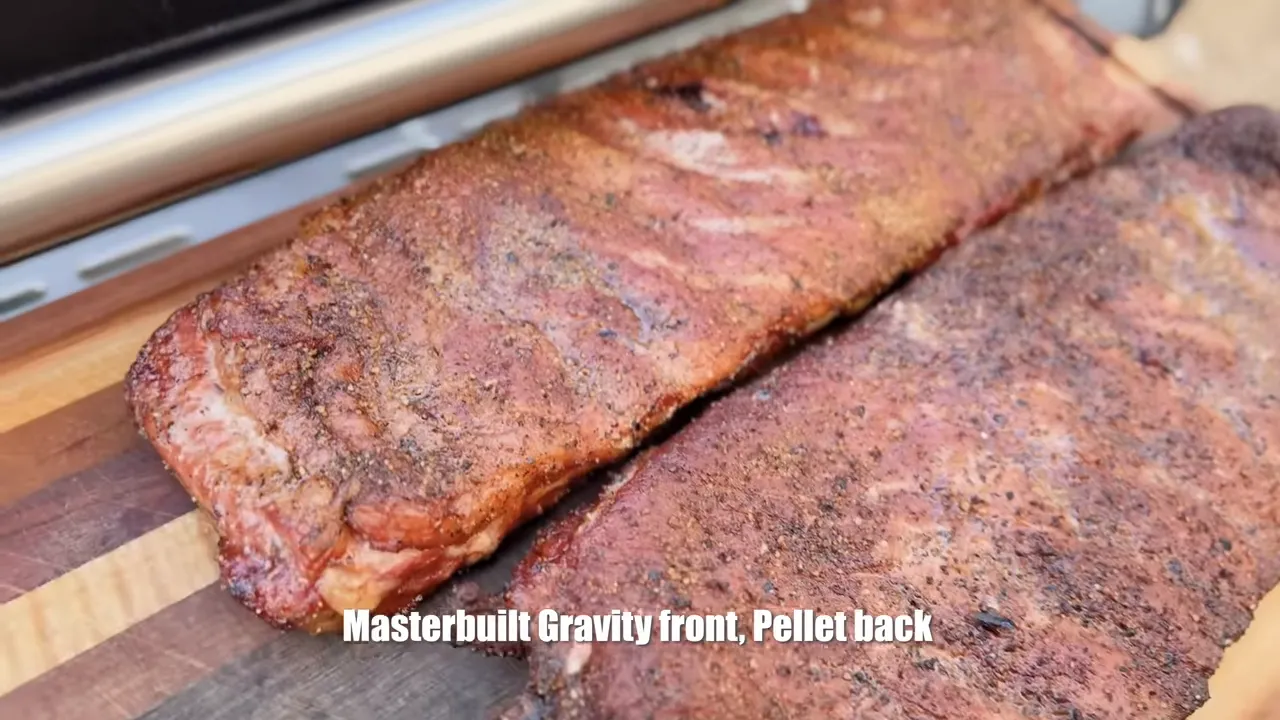
The Taste Test
The pellet ribs had good seasoning. The salt, pepper, and garlic came through nicely.
Then I tried the Gravity XT ribs. Tender, a clean bite-through, and a much more pronounced smoke flavor. That layered wood setup delivered the kind of Texas-style smoke character I was after.
For my taste, the difference was night and day. The XT ribs had a darker bark, excellent rendering, and a depth of smoke I did not get from the pellet ribs, even with the extra tube.
My smoke-flavor winner was the Gravity XT, hands down.
This is the subjective part of the comparison. Darker bark is visible; my preference for the smoke profile is personal. But if bold smoke flavor is high on your list, this result was every bit as important to me as the fuel numbers.
Test 3: Can They Put a Proper Sear on a Tomahawk?
A smoker that handles ribs is one thing. A grill also needs to finish a steak with some authority.
For this test, I picked up two tomahawk ribeyes and used the same salt, pepper, and garlic seasoning. Keep it simple and let the beef be the hero.
The Reverse-Sear Setup
- Set both grills to approximately 300°F.
- Cook the steaks to an internal temperature of about 120°F.
- Remove the steaks while bringing each grill to its maximum temperature.
- Use an infrared thermometer to measure the surface temperature of a cast-iron pan inside each grill.
- Sear the steaks and compare the results.
The 120°F reading was the pull point before searing, not a final food-safety recommendation. For safe final temperatures, refer to the safe minimum internal temperature chart.
The pan gave me a surface-temperature reference rather than relying only on the grill’s digital display.
Pellet Grill: Heat, but Not the Crust I Wanted
After about 20 minutes at its maximum setting, the pellet grill produced cast-iron readings in the 400°F range. I described its best result as the mid-400s, while one recorded infrared check showed approximately 406°F.
I stopped the steak’s finishing stage after one minute per side. These were not inexpensive steaks, and I did not want to keep cooking the interior while chasing a crust that was not developing quickly enough.
The seasoning was good, but the steak was missing that satisfying browned exterior. Like a hot dog without a bun, something important just was not there.
Gravity XT: Over 700°F and a Clear Difference
The Gravity XT pushed the cast-iron surface well above 700°F, with a recorded check around 764°F. Its digital display also showed temperatures over 700°F.
That extra heat translated into the result I wanted: a much more convincing sear and a crust that made the steak feel complete.
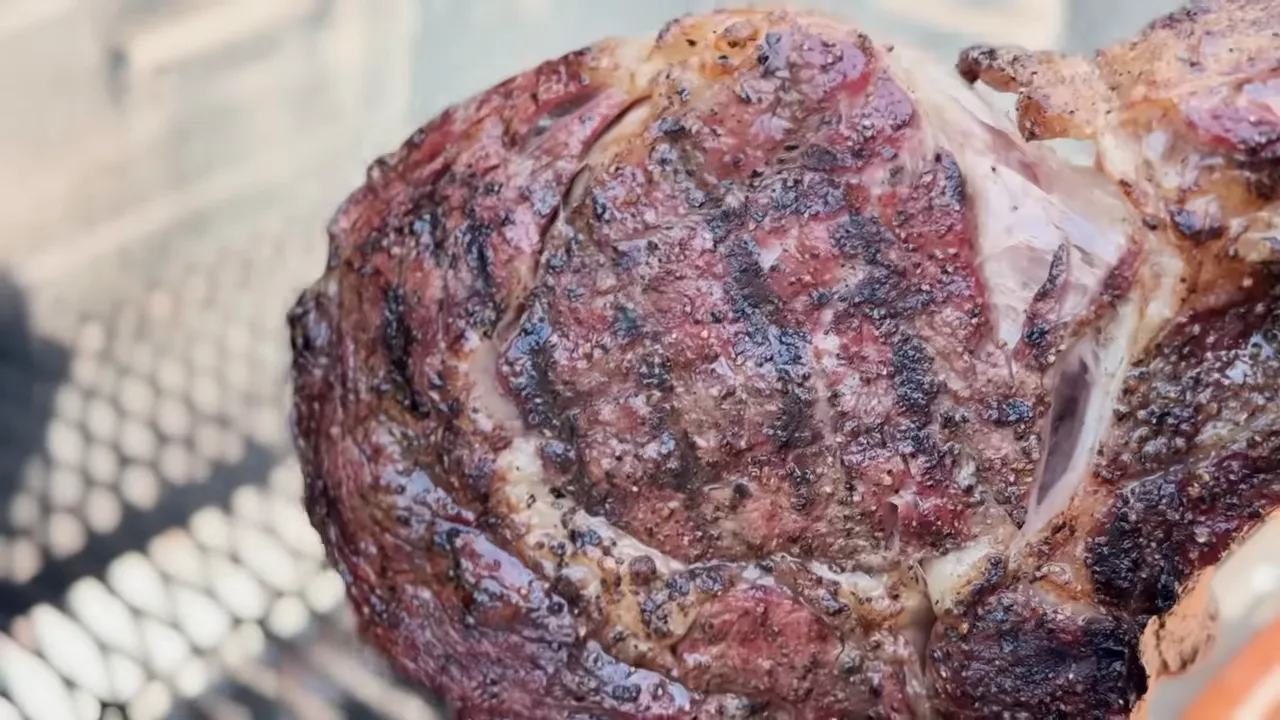
The flavor difference was immediate. I did not need much deliberation on this one.
The Gravity XT won the searing test. The measured surface temperatures and the finished steak both pointed in the same direction.
Those results demonstrate the high-heat advantage of this XT over the pellet grill I tested. They do not establish a universal maximum temperature for every pellet grill or every searing accessory.
The Verdict: Team Charcoal Takes This One
I started with three questions, and the Masterbuilt Gravity XT gave me three clear answers:
- Fuel economy: A 17-hour full-hopper runtime versus 12.5 hours, plus a lower fuel price per pound.
- Smoke flavor: The richer, wood-driven rib flavor I preferred, even against a pellet grill using a supplemental smoke tube.
- Searing power: Cast-iron surface temperatures above 700°F and a substantially better crust on the tomahawk.
The strongest takeaway is not simply “charcoal wins.” It is that fuel cost, smoke character, and actual searing performance deserve as much attention as the purchase price.
For my cooking, the XT delivered across all three. It handled the long smoke, gave me the rib flavor I wanted, and turned up the heat when it was time to finish a steak. If I were choosing again between these two grills, I know which team I would be on.
A Note From My Sponsor
I spend plenty of time thinking about brisket bark and not nearly enough thinking about my own skin. Until someone invents smoking wood with SPF built in, I have been trying to take that a little more seriously.
Geologie’s skincare quiz helped me choose a personalized routine for concerns such as under-eye bags and sunspots. The sponsored offer is 70% off your first personalized skincare trial subscription box with code BBQ70, plus the advertised 50% add-on offer.
|


